Short answer: a pellet mill is industrial when it is built to run many hours in a row, every day, at hundreds of kilos to several tons per hour. Up to about 500 to 800 kg/h, a large flat die of 360 or 400 mm, costing under USD 10,000, is enough. Above that, or if you will run two or three shifts, you need a ring die: Meelko's range goes from 500 kg/h to 3 t/h and from USD 42,000 to USD 72,000. But the machine is only part of it: an industrial pellet mill needs a line around it. Below: what makes it industrial, what it needs and how to decide.
What makes a pellet mill industrial
It is not just size. A farm pellet mill and an industrial one can make the same pellet; the difference is how many hours it can take and how much control it gives over the process:
- Continuous duty. It is built for full shifts, not one or two-hour batches. You can see it in the weight: the MKFD360C weighs 510 kg; the ring die MKRD420C-W, 3,000 kg.
- Controlled feeding. Material enters through a feeder that meters the flow, not by hand.
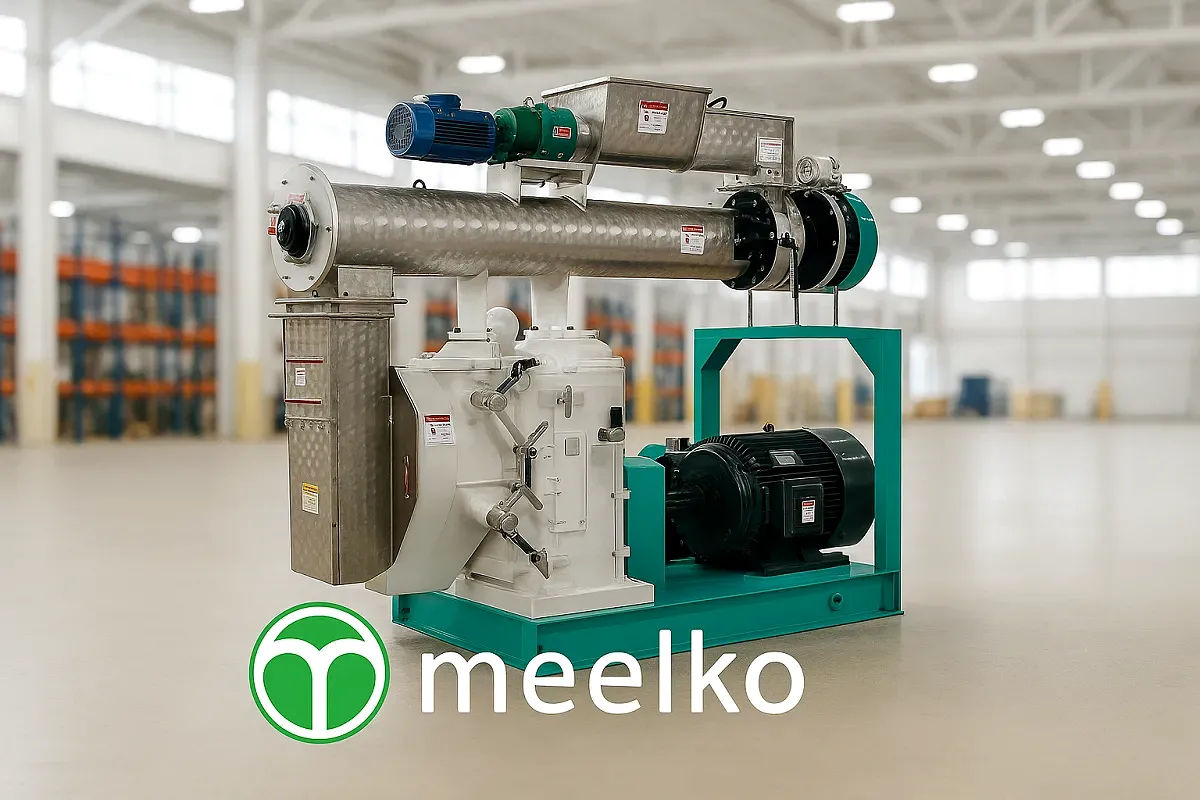
- Conditioning. In animal feed, the mash is heated with steam before pressing so the pellet comes out firmer. The MKRD508C-W has an integrated twin-shaft steam conditioner.
- Die and rollers as consumables. They are adjusted to compensate wear and replaced on a plan. The ring die is offered with 4, 6, 8 and 10 mm holes.
- A real installation. Three-phase power with headroom (50 to 160 kW on ring die mills), a solid foundation and space for the line.
Large flat die or ring die
A flat die is a perforated disc with rollers turning on top. It is simple, affordable and easy to maintain, and in its large sizes it reaches commercial output:
- MKFD360C: 360 mm, 22 kW, 680 to 820 kg/h on feed. USD 9,393.
- MKFD400P: 400 mm, PTO driven, 800 kg/h. USD 9,718.
In a ring die mill, the die is a ring turning around the rollers and the pellet exits outward. It compresses harder, gives denser and more uniform pellets, and is designed for thousands of hours of continuous work:
- MKRD350C-W: 350 mm, 50 kW, 500 to 700 kg/h. USD 42,000.
- MKRD420C-W: 420 mm, 90 kW, 1,000 to 2,000 kg/h. USD 65,000.
- MKRD508C-W: 508 mm, 90 to 160 kW depending on the project, 1,000 to 2,500 kg/h on wood and 1,500 to 3,000 kg/h on feed. USD 72,000.
One point worth being clear about: a ring die costs more per kilo/hour installed. The MKFD360C works out at about USD 12,000 per ton/hour; the MKRD420C-W, over USD 30,000. A ring die is not chosen on price: it is chosen because it can run all day, every day, and because the pellet comes out denser, which is what the wood pellet market and quality feed demand. For short batches or farm output, a flat die is the better deal. The full flat die table is in pellet mills from 120 to 400 mm.
What it needs around it
An industrial pellet mill delivers its rated output only if the material arrives well prepared. The typical line is:
- Grinding, even and fine: a hammer mill with a small screen (see hammer mill for grain).
- Drying, for wood or wet biomass: the material must enter at even moisture.
- Mixing, for animal feed.
- Steam conditioning, for animal feed. This means a boiler.
- Pelleting.
- Cooling and screening: the pellet leaves hot and soft; the cooler hardens it and the screen removes fines, which go back to the process.
- Bagging or silo.
That is why, at industrial scale, it pays to think about the whole plant and not the machine alone. How to size it for the tons you will sell is in pellet plant capacity, and investment and consumption figures in pellet plant costs and profitability.
A calculation to decide
Start from tons per year and the hours you will run:
- A feed mill aiming for 1,500 tons a year on one shift (about 1,760 effective hours): 1,500,000 kg / 1,760 h = 850 kg/h. That is at the top of the largest flat die; two MKFD360C, or one MKRD350C-W running longer hours, solve it. If you plan to grow, go ring die.
- A cooperative aiming for 8,000 tons of feed a year on two shifts (about 3,500 hours): 8,000,000 kg / 3,500 h = 2,300 kg/h. No question: ring die, and the MKRD508C-W, with its steam conditioner, delivers that volume with margin.
- A sawmill aiming for 3,000 tons of wood pellets a year on one shift: 3,000,000 kg / 1,760 h = 1,700 kg/h of wood. The MKRD420C-W would be at its limit; the MKRD508C-W does it with margin.
To run this calculation with your own numbers, the pellet line sizing tool walks you through it.
Common mistakes
- Buying the pellet mill without the line. Without fine grinding, even moisture and cooling, no industrial mill delivers what it promises.
- Running a flat die at its limit every day. Always at the top and with abrasive material like wood, die and rollers wear out fast.
- Choosing a ring die for few hours. If you will produce in batches, the investment does not pay back.
- Forgetting the boiler. Industrial-quality feed is steam conditioned: budget for it.
Conclusion
An industrial pellet mill is chosen on the hours it will run and the kilos per hour it must sustain: a large flat die up to about 800 kg/h in batches or one shift, a ring die for continuous production and larger volumes. And always with the full line around it. Meelko, an American brand of agro-industrial machinery, offers industrial ring die pellet mills from 500 kg/h to 3 t/h and complete plants. Tell us what material you will pellet, how many tons a year and on how many shifts, and we will recommend the machine and the line.