Short answer: a roller mill grinds grain by squeezing it between fluted rollers, gradually and in several passes, and separates fine flour from bran. That is why it is the mill for bread-making wheat flour and for fine corn or rice flour. For animal feed, a hammer mill is almost always the better choice: cheaper and more versatile. Meelko offers roller mills from 80 to 600 kg/h, starting at USD 4,657. Below: how it works, what it grinds and how to choose.
How a roller mill works
Grain falls from a hopper between fluted rollers, with grooves cut into the surface, turning at different speeds. As it passes between them, the kernel opens and is ground progressively instead of being shattered at once. Then:
- An air and sieve separation system removes the flour that has reached the target fineness.
- Coarse particles return to the rollers for a second grind.
- The bran exits through a separate outlet.
The result is even flour with little bran that does not overheat, plus a second product, bran, sold for animal feed. On MKFMA series models the main roller ranges from 280 to 500 mm in diameter: the larger, the more capacity.
Which grains it grinds well
- Wheat: its main use. Clean and at even moisture, it gives white bread flour with bran separated.
- Corn: flour for arepas, polenta, tortillas and blended flours.
- Rice: fine rice flour, from already hulled rice.
- Other similar dry cereals, such as barley or rye.
What it does not do well: fibrous materials (alfalfa, stalks, wood), wet or oily grains, and multi-ingredient feed mixes. That is the hammer mill's job.
Roller or hammer: when to use each
- Flour for human consumption with bran separated: roller.
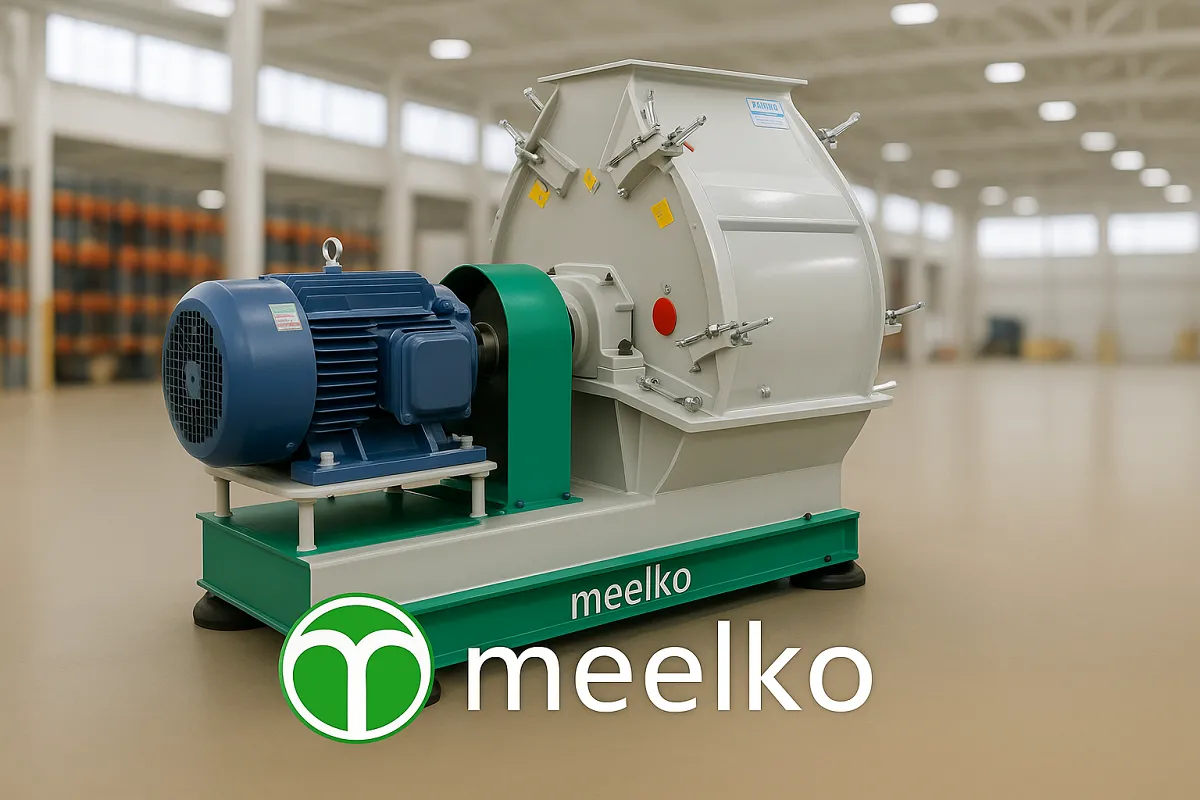
- Animal feed, whole-grain flour, biomass: hammer. It grinds everything together, accepts almost any dry material and costs less. See hammer mill for grain.
The full comparison, with energy use and wear, is in hammer mill vs roller mill.
Other "roller" machines that get confused with it
- Rice huller: also uses rollers, but rubber ones, to remove the husk without breaking the grain. The rice mill up to 280 kg/h (USD 1,693) cleans, hulls and polishes.
- Roller compaction granulator: presses powder between two rollers to make fertilizer granules. It does not grind; it does the opposite. See fertilizer granulators.
- Grain roller or crimper: flattens whole grain for cattle without making flour. If what you need is to prepare rations, a hammer mill with a coarse screen does the same job.
Which model to choose
Compact: one machine, flour ready
- Up to 130 kg/h: 80 to 120 kg/h, 4 kW, 220 kg. USD 4,657.
- Up to 350 kg/h: 7.5 kW. USD 5,306.
- Up to 400 kg/h: 11 kW three-phase, 600 kg. USD 6,435.
- Up to 600 kg/h: 22 kW three-phase. USD 9,031.
MKFMA series: more process control
- MKFMA-28M: 280 mm roller, 100 to 150 kg/h, 5.5 kW. USD 5,322.
- MKFMA-50M: 500 mm roller, 200 to 250 kg/h, 11 kW. USD 8,742.
- MKFMA-35AS: semi-automatic, 130 to 175 kg/h. USD 9,241.
- MKFMA-50AD: 400 to 500 kg/h. USD 22,512.
Semi-automatic models (AS) regulate grain intake on their own and need less operator attention; AD models are designed for long continuous runs.
Complete kits
Mill, separation and flour discharge in one assembled unit, such as the 400 kg/h kit (USD 6,854) or the automatic 500 kg/h kit with double sifter (USD 12,136).
How to go from the tons of flour you will sell to kilos of grain per hour, with flour yield and the bran left over, is in wheat flour mill. For corn and rice, see corn and rice flour mill.
Two worked examples
From every 100 kg of wheat, a flour mill generally yields 70 to 75 kg of flour; the rest is bran. With that:
- A bakery using 300 kg of flour a day needs to grind about 410 kg of wheat (300 / 0.73). Over 4 hours that is about 100 kg/h: the compact mill up to 130 kg/h is enough, at 4 kW. To grind in 2 hours, the up to 350 kg/h model.
- A community mill selling 2 tons of flour a day needs about 2,700 kg of wheat. On a 7-hour shift that is about 390 kg/h: the automatic 500 kg/h kit does it with margin and delivers flour ready to pack, plus about 700 kg of bran a day to sell to local farmers.
Capacities on product pages are indicative and depend on grain and fineness: calculate on grain and leave margin.
What to plan for
- Clean grain: stones, dirt and metal damage the rollers and end up in the flour. Pre-cleaning is part of the line.
- Even moisture: very dry grain gives more dust and more bran in the flour; too wet, it clogs.
- Power: from about 400 kg/h, mills are three-phase.
- Permits: selling flour for human consumption requires a licensed facility and labeling under your country's rules.
Conclusion
A roller mill is the right choice when the product is flour for human consumption and the bran must come out separately: wheat, corn or rice. For feed and other materials, use a hammer mill. Meelko, an American brand of agro-industrial machinery, offers roller flour mills from 80 to 600 kg/h and complete kits. Tell us which grain you will grind and how much flour you want to produce, and we will recommend the model.