Two grinding principles, two different results
Every pellet, feed or flour line starts at the mill, and the choice between hammers and rollers conditions everything that comes next: particle size, power consumption, wear and even the performance of the pellet mill or the extruder. These are two technologies that solve different problems, and choosing wrong means years of paying for more energy or producing a material that does not suit your process.
A hammer mill grinds by impact: a rotor with swinging hammers spins at high speed, strikes the material and throws it against a perforated screen. Particles leave once they are smaller than the screen holes. A roller mill grinds by compression and shear: the material passes between two fluted cylinders rotating at different speeds, which break it in a controlled way. There is no screen: the final size is set by the gap between the rollers.
Hammer mill: versatility and fineness
It is the most widely used mill in agro-industry because it accepts almost any dry material: corn, sorghum, soybean, wheat, pellets, bran, husks, wood chips, sawdust, crop residues and even bones. Particle size is changed in minutes by swapping the screen, with typical perforations of 1 to 12 mm. It produces irregular particles with a wide size distribution and a certain share of fines.
Advantages
- Versatility: one mill for grain, forage and woody biomass.
- Fineness: the only practical option for fine grinding below 1 mm, as required by pet food extrusion or wood pellets.
- Entry cost: a 1.5 kW hammer mill for 100 to 200 kg/h starts at just over USD 1,300; 7.5 kW models for 360 kg/h run around USD 2,200 to 3,300.
- Simple spare parts: reversible hammers and screens are cheap and can be changed without special tools.
Limitations
- Consumption: grinding by impact uses 30% to 50% more energy than compression for the same average particle size. In corn for feed, a hammer mill needs 8 to 15 kWh per ton versus 5 to 9 kWh for a roller mill.
- Heat and fines: impact generates heat that can affect vitamins and oils, and produces dust that must be controlled.
- Noise: it is the loudest machine in the plant and is best isolated.
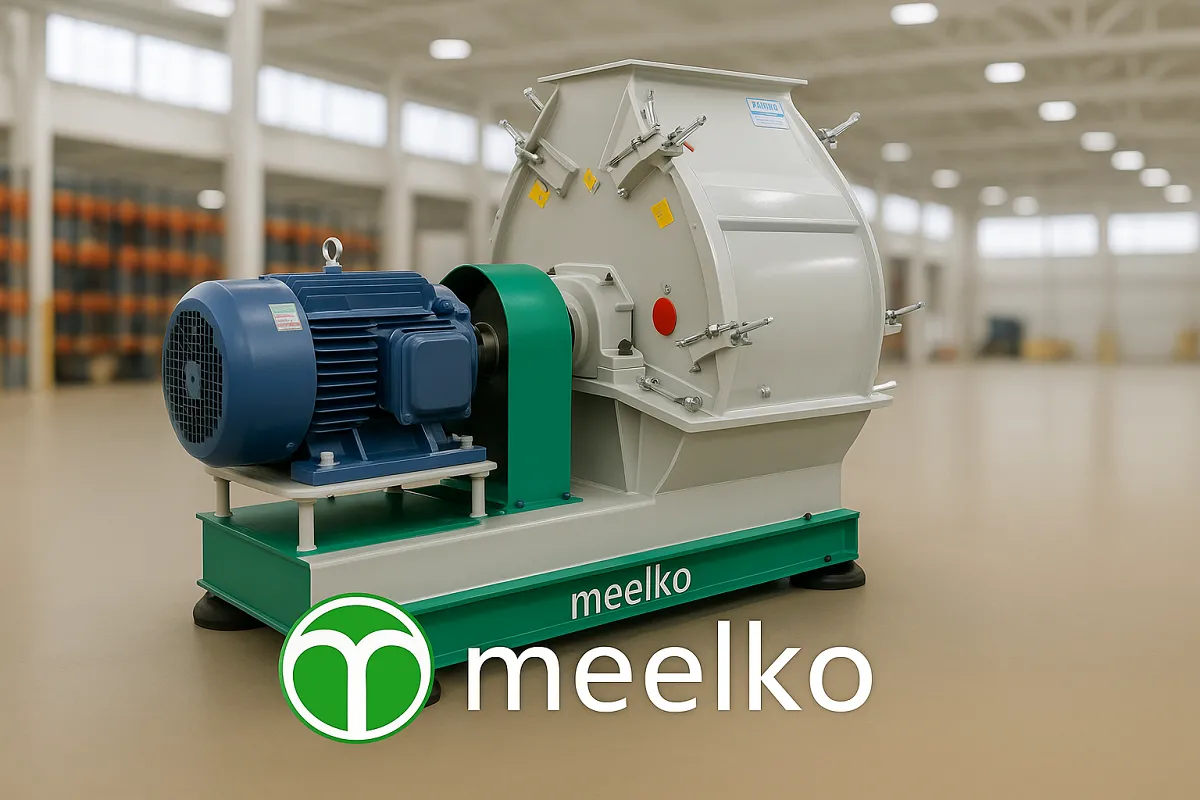
Meelko hammer mill range
Meelko manufactures hammer mills from the single-phase 1.5 kW model for 100 to 200 kg/h up to 22 and 30 kW biomass shredders delivering 540 to 680 kg/h, in electric, gasoline and diesel versions for plants without three-phase power. There is also a stainless steel line for food-grade flours and spices.
Roller mill: uniformity and low consumption
The roller mill is the specialist for dry grain: corn, wheat, barley, oats, sorghum. The fluted rollers crack the kernel into fragments of the set size, with very little generation of fines and no heating of the product. That is why it dominates in wheat flour milling, in corn cracking for cattle and in brewing, where the grain must be split without pulverizing the husk.
Advantages
- Uniform particle size: even, regular particles, ideal for cattle digestion and for flour extraction.
- Lower consumption: 30% to 50% less energy than a hammer mill on the same grain.
- No heating: preserves nutritional quality and avoids moisture losses.
- Less dust and less noise: a cleaner working environment.
Limitations
- Fibrous and wet materials: forages, crop residues, husks and woody biomass clog the rollers or do not break properly. For those you need a hammer mill.
- Very fine grinding: going below 0.8 mm requires several roller passes and intermediate sifting, as in a complete flour mill.
- Higher investment: a roller mill costs 40% to 80% more than a hammer mill of similar capacity, and roller re-fluting is a specialized job.
Meelko roller mill range
In its flour mill line Meelko offers from the MKFMA-28M at 5.5 kW for 100 to 150 kg/h up to the MKFMA-50AD at 27 kW for 400 to 500 kg/h, plus complete wheat milling kits with sifting from 300 to 600 kg/h. They are designed for bakery flours and for small and medium milling operations.
Which one to choose by material
- Corn and grains for poultry and pig feed: hammer mill if you need fine grinding and fast mixing; roller mill if you prioritize consumption and uniformity in large batches.
- Cracked grain for cattle: roller mill, no contest. Coarse, even cracking improves digestibility and reduces acidosis.
- Wheat, rice or corn flour for human consumption: roller mill with sifting, in stainless steel.
- Alfalfa, pasture, stover and forages: hammer mill. We explain it in our guide on grinding processes for alfalfa pellets.
- Wood chips, sawdust and biomass for pellets: hammer mill with a 4 to 6 mm screen, often preceded by a chipper.
- Ingredients for pet food extrusion: hammer mill with a fine 1 to 1.5 mm screen, because the extruder demands a homogeneous meal.
- Raw material for organic fertilizers: hammer mill, because of the moisture and the fibers.
How to size the mill
The mill should have 20% to 30% more capacity than the machine it feeds, because real capacity drops with fine grinding and wet materials. A mill delivering 500 kg/h with a 6 mm screen can fall to 300 kg/h with a 2 mm screen. If the pellet mill produces 500 kg/h, the mill should be specified for 600 to 700 kg/h at the particle size you will actually use. Plan the dust extraction too: a hammer mill without a cyclone or bag filter fills the plant with dust within hours.
Conclusion
The hammer mill is the Swiss army knife of agro-industry: it grinds everything, fine and with a small investment, at the cost of more energy and more dust. The roller mill is the dry grain specialist: uniform, quiet and cheap to run, but limited in materials and fineness. Meelko manufactures both technologies in capacities from 100 to 700 kg/h, with electric, gasoline or diesel motors, and ships throughout the Americas. If you are not sure which one suits you, tell us what material you will grind, at what moisture and what particle size you need.