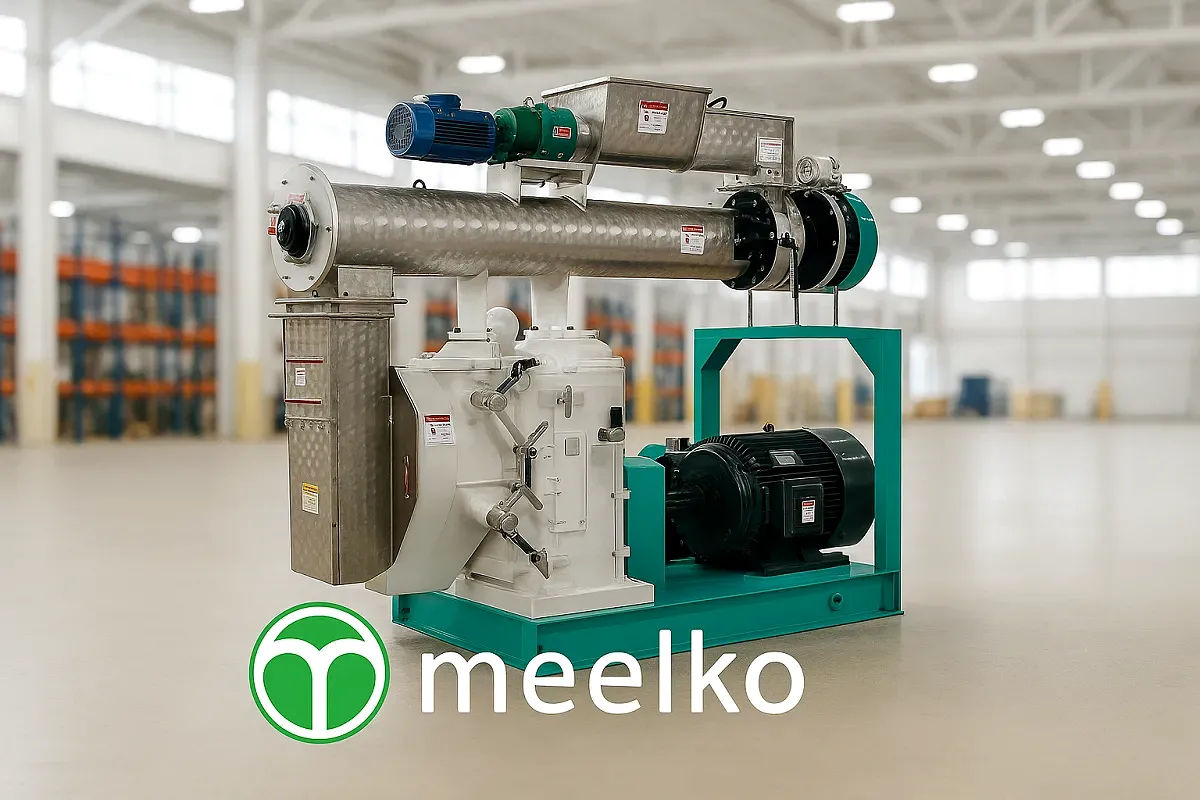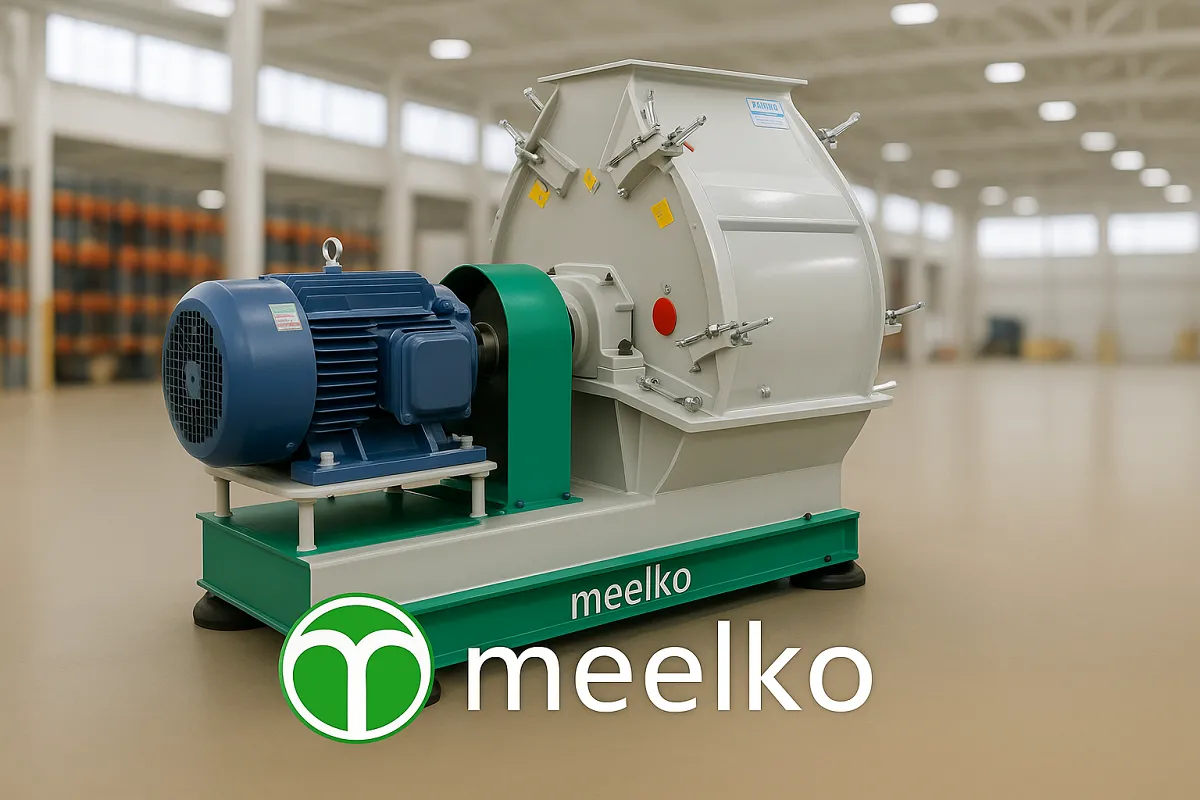
Short answer: a hammer mill breaks grain by impact and lets it out only when it passes through the holes of a screen. The screen sets the fineness: small holes (2 to 3 mm) for feed that will be pelleted, larger ones (5 to 8 mm) for cattle rations. A small mill is run by a single person, and so is a large one when it is fed by a screw conveyor and discharged by a cyclone. Meelko offers models from 100 to 1,500 kg/h, priced from USD 1,338 to USD 12,668. Below: how it works, how to choose the screen, how to feed it and which model fits.
How a hammer mill works
Inside a chamber, a rotor with swinging hammers spins. On Meelko's MKH line the rotor turns at about 3,000 rpm. Grain enters from the top, the hammers strike it against the walls and break it, and the particles keep circulating until they are smaller than the holes of the screen around the rotor. Only then do they leave.
This has three practical consequences:
- The screen rules. The same mill gives fine meal or coarse cracked grain depending on the screen fitted. Screens are interchangeable: buy the mill with two or three sizes.
- The screen also sets capacity. With small holes the grain takes longer to exit and the mill produces fewer kilos per hour.
- It handles almost anything dry. Corn, sorghum, feed wheat, barley, soybean, alfalfa and biomass too. It is not the right mill for bread-making wheat flour: that needs a roller mill, as explained in hammer mill vs roller mill.
Which screen to use for each purpose
These are typical industry ranges, for guidance only. The exact size depends on the formula and on what you do with the ground material next:
- Feed that goes to the pellet mill (poultry, pigs, rabbits, fish): 2 to 3 mm screen. An even, fine grind makes a firmer pellet with fewer fines.
- Mash feed for poultry and pigs, not pelleted: 3 to 5 mm. Too fine and birds eat less and the barn gets dusty.
- Cracked corn for cattle or feedlots: 5 to 8 mm or more. Ruminants only need the kernel broken; a finer grind wastes energy and capacity.
- Biomass or sawdust for wood pellets: 4 to 6 mm, depending on pellet diameter.
If you will pellet alfalfa, see grinding for alfalfa pellets for particle sizes in more detail.
How it is fed: by hand, hopper or screw conveyor
A hammer mill performs best when it receives grain steadily and without interruptions. Fill it all at once and the motor stalls; feed it in bursts and it produces less than it can.
- Manual loading through the top inlet. Standard on small mills: the bag is emptied into the hopper gradually. Enough for a few hundred kilos a day.
- Buffer hopper with a gate. A large hopper above the mill and a gate to regulate the flow. The operator fills it and does other work while it grinds.
- Screw conveyor from the silo or intake hopper. The way to run for hours without handling bags. How to choose the conveyor is covered in screw conveyor, bucket elevator or belt.
Two things to plan from the start: a magnet or stone trap before the inlet (a bolt or stone in the grain damages hammers and screen), and the outlet. Models with fan and cyclone, such as the MKH420C-C or the MKH500C, convey the ground product by air and discharge it where you need it, with far less dust.
How many operators it needs
- Small mill with manual loading (100 to 400 kg/h): one person, who loads and bags. If it runs one or two hours a day, it is the same person who does the other farm tasks.
- Medium or large mill with hopper or screw conveyor and cyclone (500 to 1,500 kg/h): one person supervising. That person can also run the mixer, or the mill and pellet mill on a small line.
- If output is bagged by hand, add a second person above about 500 kg/h: bagging, not the mill, is what needs labor.
Which model to choose
The most compact: for small farms
The MKH158B weighs 80 kg, runs on 1.5 kW single-phase power and grinds 100 to 200 kg/h. It costs USD 1,338. It suits a small farm making its own feed or supplying a 120 to 150 mm pellet mill.
Medium: 300 to 700 kg/h on three-phase power
- MKH198B: 7.5 kW, 300 to 400 kg/h. USD 2,237.
- MKH420B: 7.5 kW, up to 500 kg/h. About 1.2 × 1.0 × 1.2 m and 320 to 360 kg. USD 3,302.
- MKH420C-C: 11 kW, up to 700 kg/h, with fan and cyclone. USD 5,006.
Large: up to 1,500 kg/h
- MKH500C: 22 kW, 900 to 1,500 kg/h, with pneumatic cyclone discharge. USD 5,538.
- MKH500C-C: 22 kW, up to 1,500 kg/h, with fan and cyclone. USD 6,869.
Without three-phase power there are gasoline and diesel versions from 300 to 680 kg/h, compared in electric, gasoline or diesel hammer mill.
A worked example
A farm that makes and pellets its own feed has a 300 kg/h pellet mill. The hammer mill must deliver at least 30% more, because with a 2 to 3 mm screen it yields well below its maximum: you need a mill rated around 600 to 700 kg/h on coarse grain. The MKH420C-C fits, and its cyclone delivers the meal ready for the mixer.
A feedlot grinding 4 tons of corn per day with a 6 mm screen in 4 hours needs 1,000 kg/h: that is the MKH500C, fed by a screw conveyor from the silo and run by one person.
Capacities on the product pages are indicative: with dry grain and an open screen they approach the maximum; with a fine screen or moist grain they drop. Choose with margin.
Common buying mistakes
- Buying a single screen. Have at least your working size and one finer or coarser for other uses.
- Sizing on maximum capacity. The "up to" figure assumes an open screen.
- Skipping the magnet. It is cheap and protects hammers and screen.
- Grinding finer than needed. It wastes energy, cuts output and adds nothing for ruminants.
Conclusion
For grain, a hammer mill is chosen on three things: the kilos per hour you need with the screen you will use, how you will feed it and how you will take the product out. With that settled, one person can run it. Meelko, an American brand of agro-industrial machinery, offers hammer mills from 100 to 1,500 kg/h. Tell us which grain you will grind, for which animal or process and how many kilos per day, and we will recommend the model and screens.