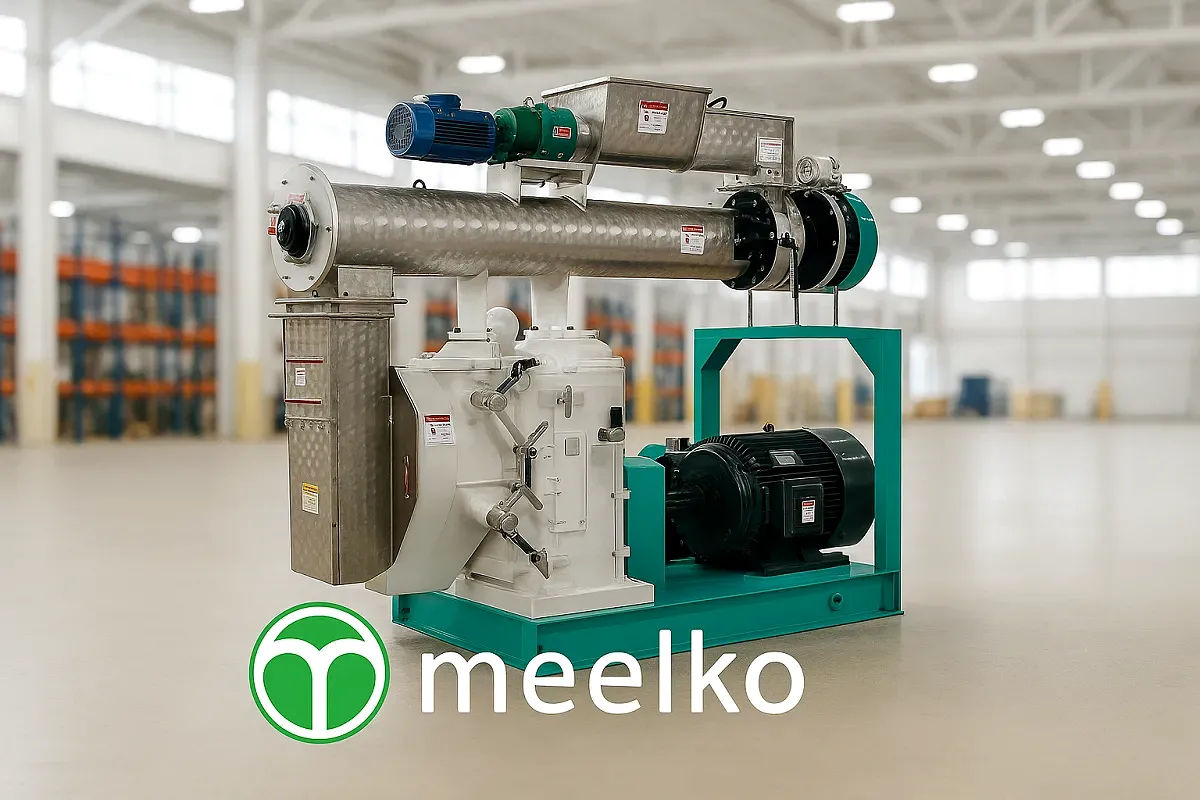
Short answer: the risk of buying a machine from a distance is not in the payment, but in finding out later that it does not perform with your material or that nobody knows how to commission it. Three things reduce it: testing your raw material before you buy, having the supplier take charge of commissioning and training, and knowing who answers after the sale. Below are the questions worth asking.
What tends to go wrong
- The stated capacity is not met. Capacity depends on the material: a machine that gives 500 kg/h with one material may give half with another. The customer finds out with the machine already installed.
- Nobody knows how to commission it. The machine arrives, with no technician or training. Weeks of trial and error follow, wasting raw material and time.
- The line is incomplete. The pellet mill was bought, but drying, cooling or the electrical power needed to make it all work were missing.
- No spare parts and no one to call. A wear part stops production, and whoever sold the machine does not answer.
None of these problems shows up in the photo or the price.
Step 1: test your raw material
It is the best way to know if the machine suits your case. In Meelko's technical test service, you send a representative sample of your material and our technicians process it on the machine best suited to your project. The test measures:
- Effective capacity, in kg/h, with your material.
- Product quality: density, hardness, appearance and uniformity.
- Energy consumption, to estimate your real costs.
- Wear and the generation of fines or residues.
At the end you receive a technical report with results, photos of the material and recommendations. You decide with data, not with a catalog promise. Whoever the supplier is, ask for this: if they will not test your material, take note.
Step 2: run the numbers before asking for prices
Many purchases fail before they start, by looking only at the machine. First work out what line you need, what it consumes and whether the business adds up. These tools are free to use:
- Pellet line sizing tool and profitability calculator.
- Power consumption: what power to contract or what generator you need.
- Fertilizer plant sizing tool and extrusion line sizing.
Step 3: secure installation and commissioning
Commissioning is what turns a machine into a factory. Meelko offers:
- On-site assembly and installation: technicians, supervision of mechanical and electrical assembly, and tests.
- Commissioning: no-load tests, progressive load and nominal capacity with your raw material, with a technical record.
- Operator training: theory and practice at your site, on safe operation and preventive maintenance.
Step 4: ask what happens after the sale
- International technical assistance: remote and on-site support.
- Annual preventive maintenance: scheduled inspections and replacement of wear parts.
- Advanced training for local technicians: so you have someone of your own who can solve problems.
Ten questions for any supplier
- Can you test my raw material before I buy?
- Is the capacity you quote with my material or the best case?
- What does the price include and what must I buy separately?
- What electrical power do I need for the whole line?
- Who installs and commissions the machine?
- Who trains my operators?
- Which parts wear out, how often are they changed and how do I get them?
- Who do I call if production stops, and in what language will they help me?
- Do you have manuals and drawings for my model?
- Can I talk to someone who already owns this machine?
The answers are worth more than the price difference. A machine stopped for months costs more than any discount saves.
Conclusion
Buying from a distance is normal in this industry: what matters is having the data beforehand and the backing afterwards. Meelko is an American brand of agro-industrial machinery, with services for testing, installation, commissioning, training and technical assistance. Tell us about your project and we will tell you where to start.