Short answer: you do not choose a dryer by the kilos of pellets you want to make, but by the water you have to remove. For 500 kg/h of dry product, sawdust at 30% moisture means evaporating about 140 kg of water per hour; sawdust at 50% means almost three times as much. Meelko offers flash dryers from USD 7,677. Below are the math and the models.
The water math
The dry part of the material does not change: only water leaves. So the calculation goes like this:
- How much dry matter the final product holds: output × (1 − final moisture).
- How much wet material you need to feed: dry matter ÷ (1 − initial moisture).
- How much water to evaporate: wet material − output.
Example with 500 kg/h of product at 10% moisture, which is 450 kg/h of dry matter:
- Sawdust at 25%: 600 kg/h goes in and 100 kg/h of water evaporates.
- Sawdust at 30%: 643 kg/h goes in and 143 kg/h evaporates.
- Sawdust at 50%: 900 kg/h goes in and 400 kg/h evaporates.
If you would rather not do it by hand, the pellet line sizing tool works it out with your output and moisture.
What gets burned to dry
Evaporating water is what takes the most energy in a pellet plant. As a rough reference, each kilo of water requires burning between 0.2 and 0.3 kg of dry biomass. In the 50% sawdust example, that is about 100 kg/h of fuel: one fifth of what you produce. With 30% sawdust, about 35 kg/h.
That leads to the first decision of the project. If the material arrives very wet, it is worth checking whether it can air-dry before the dryer, or whether buying it drier makes sense even at a higher price. To see how it weighs on the business, use the pellet plant profitability calculator.
The models
For material up to 25% moisture
- 200 to 250 kg/h: 5.5 kW. USD 7,677.
- 400 to 500 kg/h: 7.5 kW. USD 9,934.
- 500 to 700 kg/h: 11 kW. USD 11,741.
For material up to 50% moisture
- 150 to 300 kg/h: 5.5 kW. USD 11,966.
- 250 to 500 kg/h: 7.5 kW. USD 15,127.
- 300 to 600 kg/h: 15 kW. USD 18,740.
- Higher capacity series: 15 kW. USD 21,709.
Comparing similar sizes, the 50% series costs about 50% more than the 25% series (USD 15,127 versus USD 9,934 at 500 kg/h). That is why you should measure the real moisture of your material before buying: if sawdust in your area arrives at 30%, there is no point paying to dry the worst case, and if it arrives at 50%, the smaller series will not do.
Real capacity depends on the material and the incoming moisture. Before deciding, confirm it with us for your case.
Flash or another type of dryer
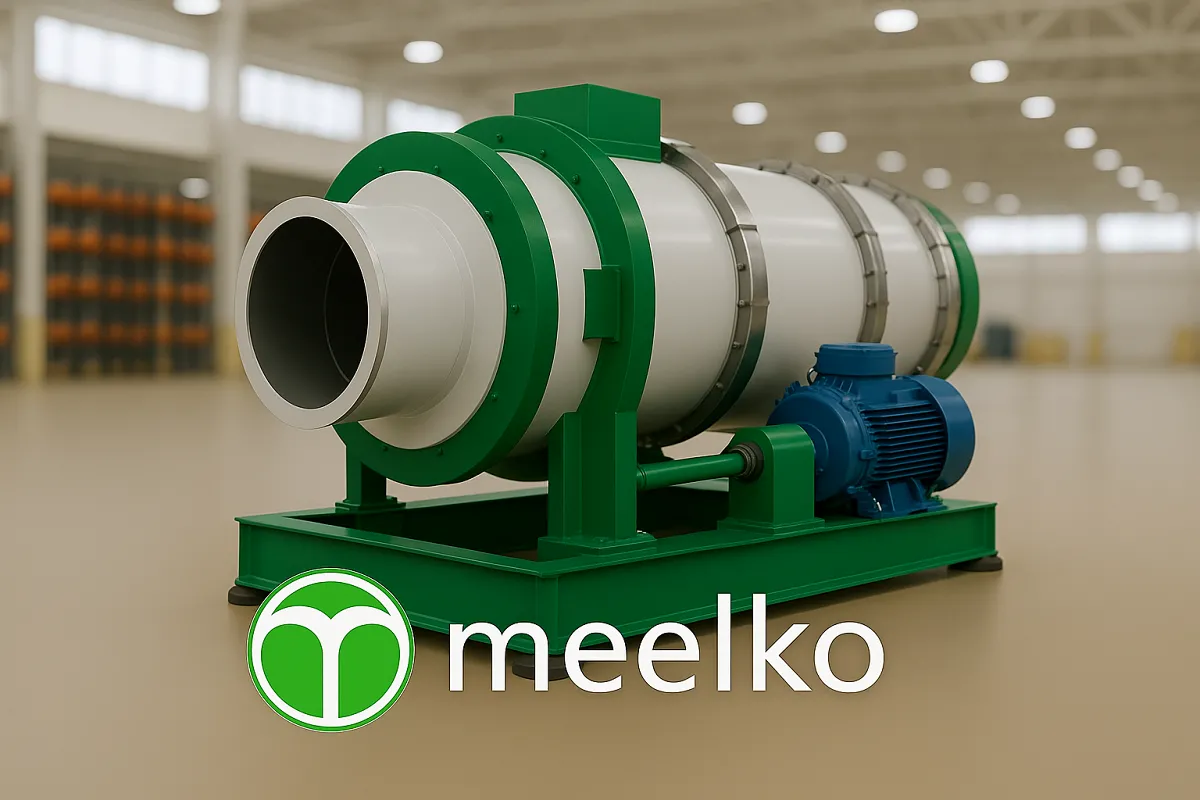
A flash dryer carries the material in fast-moving hot air and dries it in seconds. It works very well with small, light particles: sawdust, shavings, bagasse, husks and wet flours. It is not meant for large pieces such as coarse chips: those need reducing first. See branch shredder or hammer mill. More on the equipment in flash dryer for biomass.
Mistakes that make the project more expensive
- Calculating with the moisture of a good day. In winter or after rain, stored material arrives wetter. Measure several times over the year.
- Forgetting the fuel. It is usually the highest cost of drying. If you generate your own residues, it is much cheaper.
- Sizing by the model name. A "500 kg/h" dryer does not yield 500 kg/h with any material. Ask about your moisture.
Conclusion
The moisture of the material defines the dryer, the fuel and a good part of the project's profitability. Measure it before asking for prices. Meelko, an American brand of agro-industrial machinery, offers flash dryers for material up to 25% and 50% moisture. Tell us what material you have, how wet it arrives and how much you want to produce, and we will recommend the model.