Why Drying Is Critical in Biomass Processing
Moisture is the number one enemy of efficient biomass processing. Whether you are producing wood pellets, briquettes, or animal feed, your raw material must reach a specific moisture content — typically 10–15% — before it can be properly compacted. Raw biomass materials like sawdust, bagasse, and rice husks often arrive at 40–65% moisture, making drying the most critical and energy-intensive step in any biomass production line.
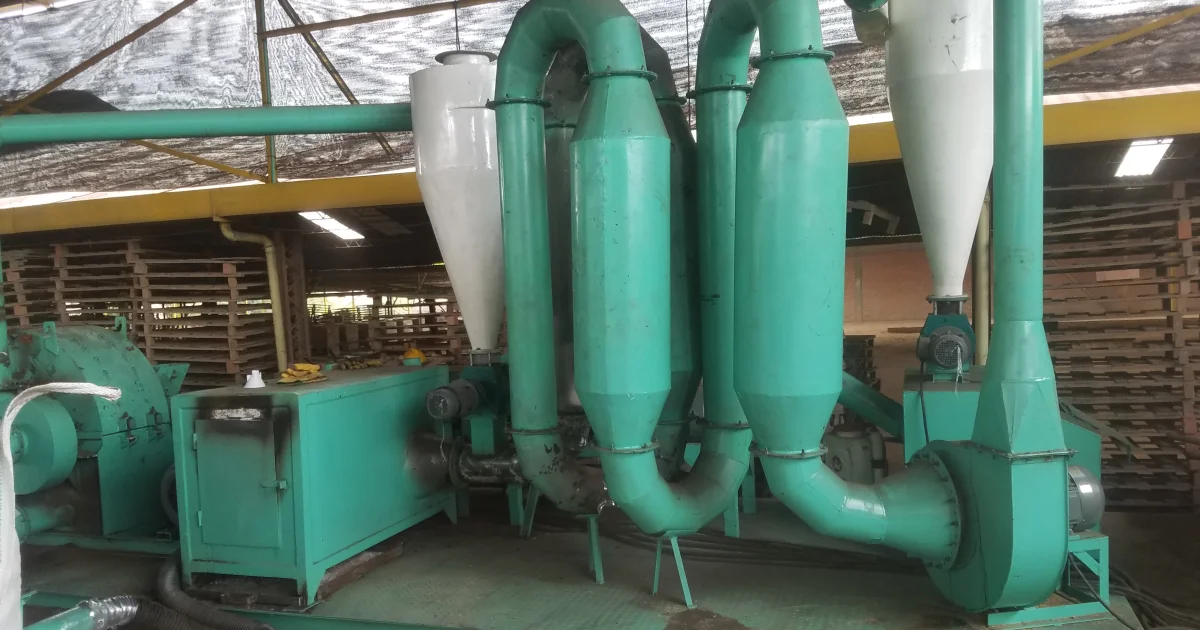
The flash dryer (also known as a pneumatic dryer) has emerged as one of the most cost-effective and efficient solutions for drying fine biomass particles. Its rapid drying cycle, compact design, and lower capital cost make it an attractive alternative to conventional rotary drum dryers for many applications.
How a Flash Dryer Works
A flash dryer operates on a simple but highly effective principle: hot air entrainment. The process works as follows:
- Hot air generation: A heat source (biomass burner, gas burner, or steam heat exchanger) heats air to 150–400°C depending on the material and desired output moisture.
- Material injection: Wet biomass is fed into the hot air stream via a screw feeder or rotary valve. The material is instantly dispersed into the fast-moving airflow.
- Rapid evaporation: Because particles are suspended in hot air with maximum surface exposure, moisture evaporates in 1–5 seconds. This is dramatically faster than the 15–30 minutes required by rotary dryers.
- Separation: The dried material and moist air pass through a cyclone separator where centrifugal force separates the dry product from the exhaust air.
- Collection: Dried material exits the cyclone bottom into a storage bin or directly onto a conveyor leading to the next processing stage.
The entire drying cycle — from wet material entry to dry product collection — takes less than 10 seconds, which is why it is called "flash" drying.
Flash Dryer vs. Rotary Drum Dryer
Both dryer types have their place in biomass processing. Here is a detailed comparison:
- Capital cost: Flash dryers cost 30–50% less than rotary dryers of equivalent capacity.
- Footprint: Flash dryers are vertical, requiring 60–70% less floor space.
- Drying time: Flash: 1–5 seconds; Rotary: 15–30 minutes.
- Particle size: Flash dryers work best with particles under 10 mm; rotary dryers handle larger chunks.
- Moisture reduction: Flash dryers typically reduce moisture by 20–30 percentage points per pass; rotary dryers can achieve 40+ points in a single pass.
- Energy efficiency: Both achieve 70–85% thermal efficiency when properly configured.
- Maintenance: Flash dryers have fewer moving parts and lower maintenance costs.
- Material handling: Flash dryers work best with fine, uniform particles — ideal for sawdust and similar materials.
For fine biomass materials like sawdust, rice husks, and milled bagasse, the flash dryer offers the best cost-to-performance ratio.
Ideal Applications for Flash Dryers
Sawdust Drying
Fresh sawdust at 45–55% moisture is reduced to 10–14% in seconds. Flash dryers handle sawdust exceptionally well due to its fine, uniform particle size. Throughput ranges from 500 kg/h to 5 tons/h of evaporated water depending on the model.
Bagasse Drying
Sugarcane bagasse at 45–52% moisture must be dried to 12–15% for pelletizing or briquetting. After milling to reduce particle size, bagasse responds excellently to flash drying.
Rice Husk Drying
Rice husks typically arrive at 20–30% moisture and need to reach 10–12%. Because the moisture reduction required is smaller, flash dryers process rice husks at very high throughput rates.
Other Applications
Flash dryers also process corn stover, wheat straw (milled), coconut shell powder, coffee husks, and various agricultural residues with particle sizes under 10 mm.
Operating Parameters
- Inlet air temperature: 150–400°C (typically 250–350°C for biomass).
- Outlet air temperature: 70–120°C (controls final moisture content).
- Air velocity: 15–25 m/s in the drying duct.
- Residence time: 1–5 seconds.
- Thermal efficiency: 70–85%.
- Power consumption: 15–75 kW depending on capacity (fan and feeder motors).
Energy Efficiency Considerations
Flash dryers achieve optimal efficiency when the heat source is matched to available biomass waste. Burning reject pellets, bark, or wood chips in a biomass burner provides free heat, reducing fuel costs by up to 100%. A well-designed system recovers 75–85% of the thermal energy input.
Key efficiency tips include: maintaining consistent feed rate, insulating the drying duct, pre-heating inlet air with exhaust heat recovery, and monitoring outlet temperature continuously to prevent over-drying.
Integration with Pelletizing Lines
Flash dryers integrate seamlessly with pelletizing production lines. A typical layout positions the flash dryer between the raw material storage and the pellet mill:
- Raw material storage → screw conveyor → flash dryer inlet
- Flash dryer → cyclone separator → dried material bin
- Dried material bin → conditioner → pellet mill
This configuration minimizes material handling, reduces floor space requirements, and enables continuous production flow.
Capacity Range
Meelko flash dryers are available in multiple capacities to match your production needs:
- Small scale: 300–500 kg/h evaporation capacity, suitable for plants producing 1–2 tons/h of pellets.
- Medium scale: 500–1,500 kg/h evaporation, for plants producing 2–5 tons/h.
- Large scale: 1,500–5,000 kg/h evaporation, for industrial operations exceeding 5 tons/h.
Choose Meelko Flash Dryers
Meelko offers a complete range of flash dryers and biomass drying solutions designed for easy integration with pelletizing and briquetting lines. Our systems include the dryer, cyclone separator, fan, biomass burner, and control panel — everything you need for a complete drying station. Contact our engineering team to size the right flash dryer for your specific biomass and production requirements.