Short answer: to move material a short distance with some incline, a screw conveyor; to lift it vertically, a bucket elevator; to move large volumes or bags horizontally, a belt conveyor. At Meelko they start at USD 1,500 for the belt, USD 1,800 for the screw and USD 3,200 for the elevator. Below is how to choose and an example line.
The three systems
Screw conveyor
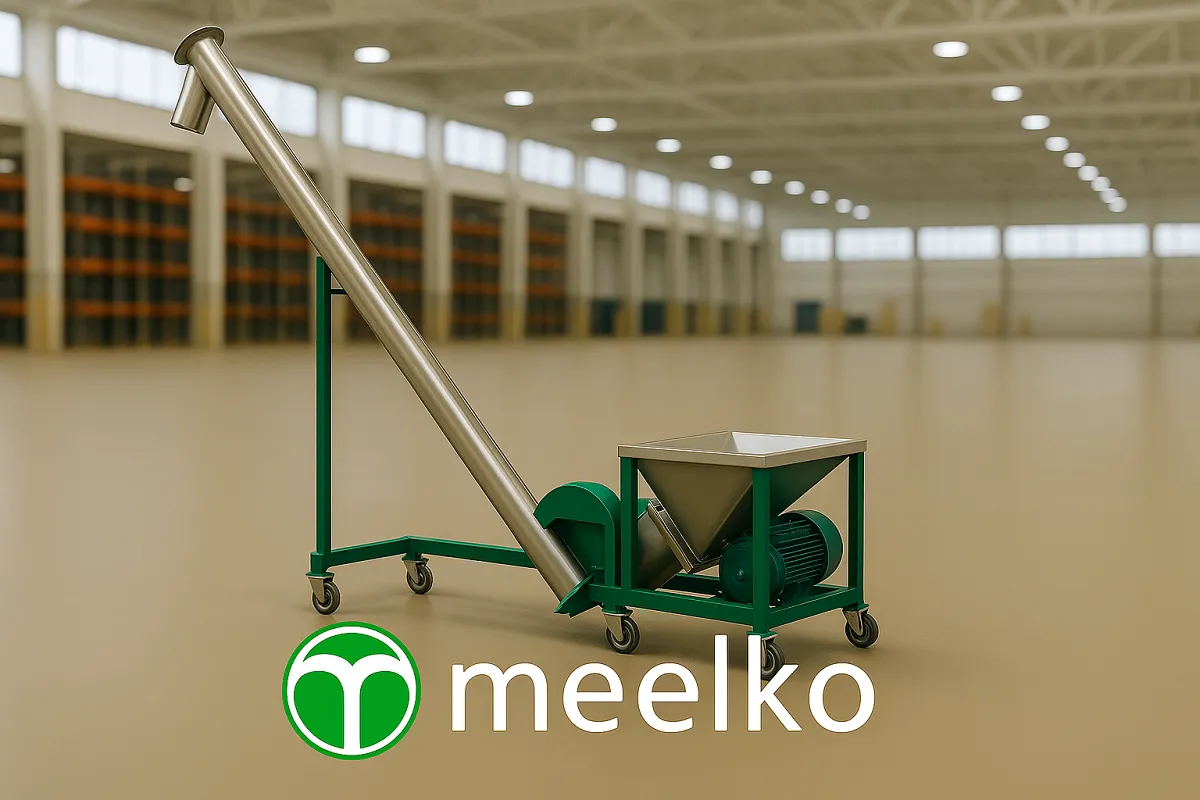
A helix turns inside a closed tube and pushes the material. It protects the product from contamination, loses little and can be installed at an incline. It is the most common way to feed hoppers, mixers and pellet mills within a line.
- MKSF-100E screw conveyor: 100 mm tube, 1 to 3 t/h, 1.5 kW, 3 meters (custom length up to 4 m), 65 kg. USD 1,800.
Bucket elevator
A belt with buckets lifts the material vertically and tips it out at the top. It takes up very little floor space and is the natural way to load silos and tall hoppers. It works for grain, seeds and balanced feed, and treats the product gently.
- MKNR-3TG bucket elevator: 3 t/h, 6 meters high (custom up to 12 m), 180 kg. USD 3,200.
Belt conveyor
A flat belt moves the material over rollers. It has a lot of capacity for the motor it uses, and it is the only one of the three that also handles bags and packages. It is open, so it does not suit fine powders.
- MKBT-400L-3 belt: 400 mm wide, 3 meters (custom length), 9 to 14 t/h, 1.5 kW, 67 kg. USD 1,500.
How to choose in four questions
- Do you need to lift it far? For more than a few vertical meters, a bucket elevator. A steeply inclined screw loses capacity.
- How fragile is the product? Finished pellets break with friction: to move them, prefer an elevator or belt over a screw. Whole grain and ground material travel well on all three.
- Does it raise dust? Flours and fine ground products do better in a closed screw or elevator.
- How many tons per hour? At 1 to 3 t/h, any of the three works. For more, the belt has the margin. For more capacity in a screw or elevator, ask us.
Example: a 1 t/h feed line
- From the intake hopper to the silo: MKNR-3TG elevator. USD 3,200.
- From the silo to the mill and mixer: MKSF-100E screw. USD 1,800. If the machines are far apart, you need more sections.
- From the bagger to the loading area: MKBT-400L-3 belt. USD 1,500.
- Total: USD 6,500 for one section of each type, with about 3 kW in screw and belt motors.
These figures are small next to the pellet mill and mixer, but conveying is what replaces carrying bags by hand.
What to define before asking for a price
- The real length and height, measured on site. Count the run between the loading and discharge points, not the distance between machines.
- The heaviest material you will move: capacities are given for grain, and lighter or fibrous material yields less.
- Where each machine sits. A good layout saves sections: if the mixer sits under the silo, material drops by gravity.
If you are building the plant, see also setting up an animal feed line and the pellet line sizing tool, which includes conveying between stages.
Conclusion
There is no single best system: a complete line usually has all three. Meelko, an American brand of agro-industrial machinery, offers screw conveyors, bucket elevators and belt conveyors. Send us the material, the tons per hour and the distances, and we will tell you which combination fits.