What Is a Rotary Disc Granulator?
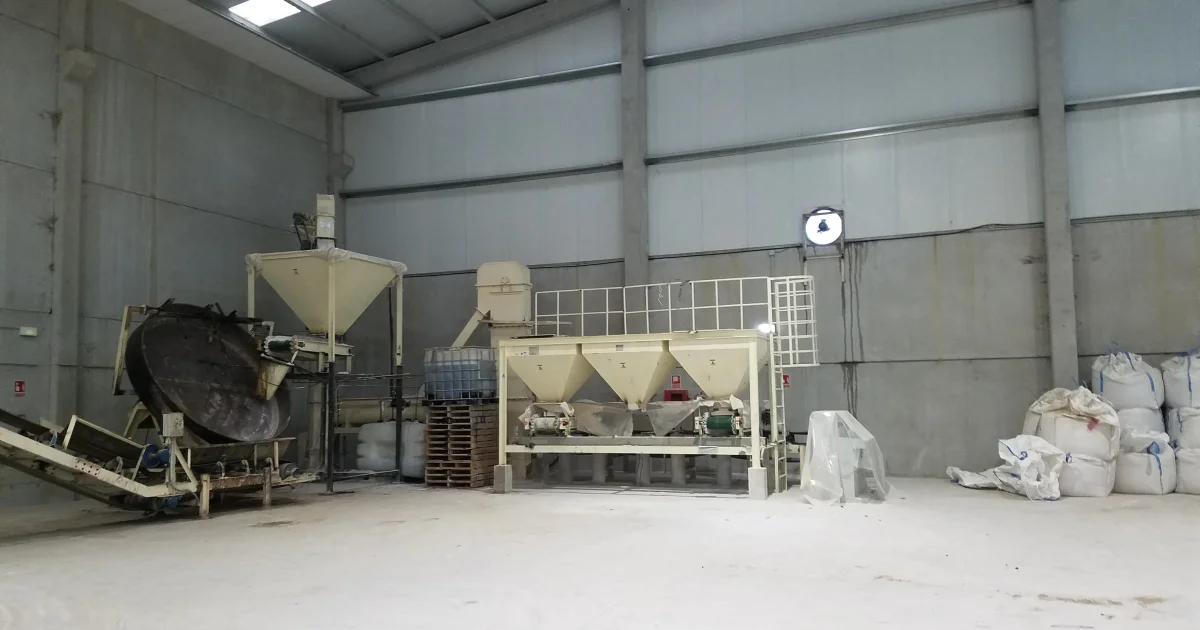
The rotary disc granulator, also known as a pan granulator, is one of the most widely used machines in the fertilizer industry for producing uniform, spherical granules. Its design is elegantly simple: an inclined rotating disc receives powdered or mixed raw materials, and through the combined action of gravity, centrifugal force, and controlled moisture addition, transforms them into round granules of consistent size.
This type of granulator is particularly popular because it offers operators a direct visual view of the granulation process, allowing real-time adjustments. With granulation rates typically between 70% and 93% on a single pass, disc granulators deliver excellent efficiency with relatively low energy consumption compared to drum granulators or compaction systems.
How the Rotary Disc Granulator Works
The granulation process involves three integrated stages:
Stage 1: Weighing and Dosing
Raw materials are precisely weighed and dosed into the granulation disc. For NPK compound fertilizers, this involves multiple ingredients that must be measured accurately to maintain the desired nutrient ratio. Modern systems use loss-in-weight feeders with accuracy of +/- 0.5% to ensure consistent formulation batch after batch.
Stage 2: Mixing and Humidification
Inside the disc, the powdered materials are sprayed with water or a binding solution through strategically positioned nozzles. The moisture content is carefully controlled between 25% and 35% depending on the material. As the disc rotates at 15-25 RPM, the materials begin to agglomerate, forming small seed granules that grow as they pick up more powder and moisture.
Stage 3: Granule Formation and Classification
The inclined disc naturally classifies granules by size. Smaller, lighter particles remain near the bottom of the disc and continue growing, while larger, heavier granules travel to the rim and discharge over the edge. This self-classifying behavior is a major advantage, producing 80-90% on-spec granules without additional screening in many applications.
Advantages Over Other Granulation Systems
The disc granulator offers several distinct benefits compared to drum granulators, extrusion granulators, and spray towers:
- Visual process control: Operators can observe the granulation in real time and make immediate adjustments to spray rate, disc speed, or feed rate. This is not possible with enclosed drum granulators.
- High granulation rate: 70-93% single-pass efficiency compared to 30-60% for many drum granulators.
- Uniform granule size: The self-classifying disc action produces granules with a narrower size distribution (coefficient of variation typically below 15%).
- Flexible capacity: Disc size can range from 0.6 m (lab scale, 50-100 kg/h) to 3.6 m (industrial scale, 5-8 tons/h), providing options for any production volume.
- Lower energy consumption: Typically 8-15 kWh per ton of product, compared to 15-25 kWh for drum granulators.
- Easy formulation changes: Switching between products requires minimal cleaning compared to enclosed systems.
- Lower investment cost: 20-40% less capital expenditure compared to equivalent-capacity drum granulation systems.
Applications
NPK Compound Fertilizers
The disc granulator excels at producing NPK blends in ratios like 15-15-15, 20-10-10, or custom formulations. It handles both chemical and physical blending approaches, producing granules with 2-5 mm diameter suitable for mechanical spreading.
Organic Fertilizers
Composted manure, biochar blends, and other organic materials granulate well in disc systems. The open design allows moisture to evaporate naturally during the process, which is beneficial for high-moisture organic inputs.
Bio-Organic Compound Fertilizers
Combining organic matter with mineral nutrients, these premium products benefit from the gentle granulation action of the disc that preserves beneficial microorganisms better than high-pressure extrusion systems.
Technical Specifications
Typical specifications for industrial disc granulators:
- Disc diameter: 1.5 m to 3.6 m
- Disc edge height: 200-450 mm
- Inclination angle: 40-55 degrees (adjustable)
- Rotation speed: 15-25 RPM (variable frequency drive recommended)
- Motor power: 3-22 kW depending on disc size
- Capacity: 0.5-8 tons/hour depending on disc size and material
- Granule size range: 2-8 mm (adjustable via process parameters)
- Machine weight: 500-5,000 kg
Maintenance Best Practices
Proper maintenance extends equipment life and ensures consistent product quality:
- Daily: Clean the disc surface and scraper blade at the end of each shift. Inspect spray nozzles for blockage. Check disc edge seals for material leakage.
- Weekly: Lubricate main bearing and gearbox. Check belt tension or direct drive coupling alignment. Inspect disc lining for wear.
- Monthly: Measure disc lining thickness (replace when worn below 3 mm). Check gearbox oil level and condition. Verify inclination angle and adjust if needed.
- Quarterly: Complete gearbox oil change. Inspect main shaft bearings for play. Test emergency stop systems. Calibrate spray system flow meters.
With proper maintenance, a disc granulator's main components last 8-12 years, with the disc lining being the primary wear component requiring replacement every 12-24 months depending on material abrasiveness.
Conclusion
The rotary disc granulator remains one of the most versatile and cost-effective solutions for fertilizer production. Its combination of visual process control, high granulation efficiency, and low operating costs makes it ideal for producers of all sizes. Meelko offers a range of disc granulators and complete fertilizer processing equipment designed for reliable, long-term operation. Contact our team to find the right granulation solution for your production needs.