The Growing Wood Pellet Market
The global wood pellet market has experienced remarkable growth over the past decade, reaching approximately $15 billion in 2025 with projections to exceed $25 billion by 2030. Driven by carbon reduction mandates, coal-to-biomass conversions in power plants, and increasing residential heating demand in Europe and Asia, wood pellets represent one of the most stable and growing segments in the renewable energy sector.
For companies considering entry into this market or looking to scale up existing operations, installing a large-scale pellet plant with capacities ranging from 1 to 10 tons per hour requires careful planning across multiple dimensions: site selection, equipment specification, regulatory compliance, and financial analysis. This guide covers each of these critical areas.
Planning Phase: Foundation for Success
Site Selection Criteria
The location of your pellet plant significantly impacts profitability. Key factors include:
- Raw material proximity: Transportation of wood residues typically accounts for 25-40% of raw material cost. Ideally, the plant should be within 80-120 km of sustainable wood sources (sawmills, forestry operations, wood processing facilities).
- Infrastructure: Access to three-phase electricity (minimum 500 kVA for 1 t/h, up to 5 MVA for 10 t/h), natural gas or biomass fuel for dryers, and paved road access for heavy truck traffic.
- Land requirements: A 1-2 t/h plant typically needs 2,000-4,000 m2 of covered production area plus 3,000-6,000 m2 for raw material and finished product storage. A 10 t/h facility may require 15,000-25,000 m2 total.
- Environmental considerations: Distance from residential areas (noise and dust), availability of environmental permits, and water supply for fire suppression systems.
Raw Material Assessment
A reliable and cost-effective wood supply is the single most critical factor for plant viability:
- Volume requirements: Approximately 2.0-2.5 tons of green wood are needed to produce 1 ton of pellets (depending on initial moisture content).
- Preferred species: Softwoods (pine, spruce, fir) produce pellets with higher energy content (4,800-5,200 kcal/kg) and lower ash. Hardwoods work but may require different die specifications.
- Moisture content: Green wood arrives at 45-55% moisture, which must be reduced to 10-12% before pelletizing.
- Contaminants: Bark content, sand, metals, and stones must be managed to meet quality standards.
Equipment Selection: The Production Process
1. Log Receiving and Debarking
For plants processing whole logs, a debarker removes bark that can increase ash content. Ring or drum debarkers process 10-50 m3/hour depending on log diameter. Investment: $30,000-120,000.
2. Chipping
A disc or drum chipper reduces logs or slabs to chips of 20-50 mm. For large plants, drum chippers with capacities of 15-80 m3/hour are standard. If receiving pre-chipped material from sawmills, this stage may be partially or fully eliminated.
3. Drying
The dryer is the largest single piece of equipment and the highest energy consumer in the plant. Rotary drum dryers are most common for large installations:
- 1-2 t/h pellet output: Dryer processing 2-5 t/h of wet material, drum diameter 1.5-2.0 m
- 5-10 t/h pellet output: Dryer processing 10-25 t/h of wet material, drum diameter 2.5-3.5 m
- Heat source: Biomass burners (using bark, sawdust, or off-spec pellets) reduce operating costs by 30-50% compared to natural gas
- Energy requirement: Approximately 900-1,100 kcal needed to evaporate 1 kg of water
4. Hammer Milling
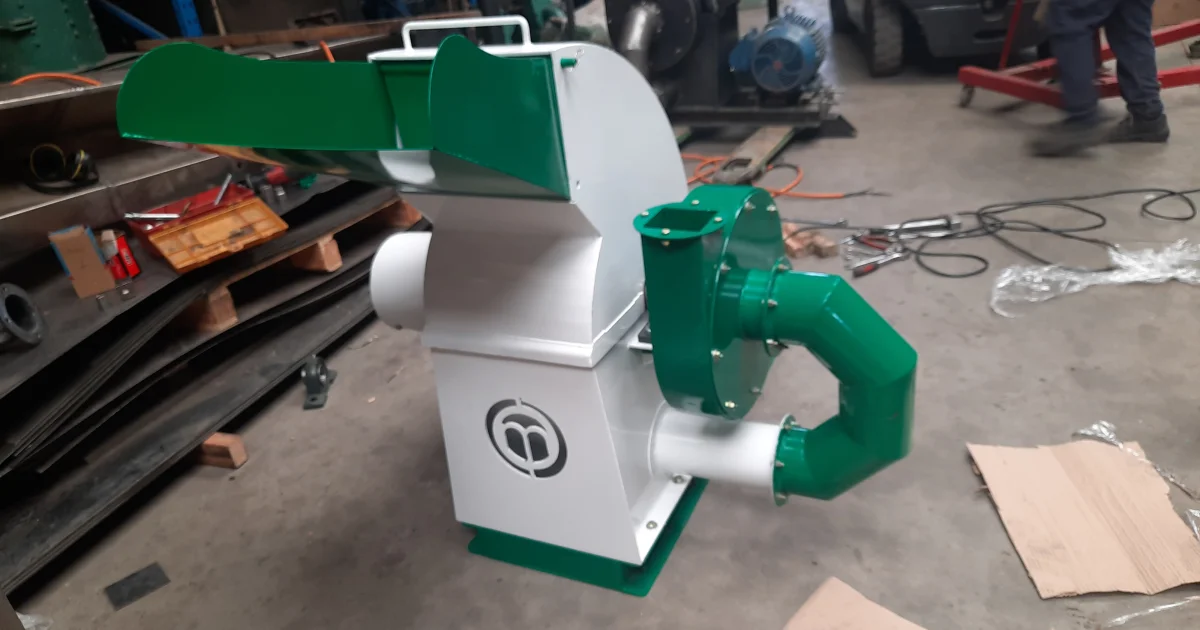
Dried chips must be reduced to particles of 2-4 mm for optimal pelletizing. Industrial hammer mills with screen sizes of 4-6 mm process 2-15 t/h depending on motor size (75-400 kW). This is the second-highest energy consumer after drying.
5. Pelletizing
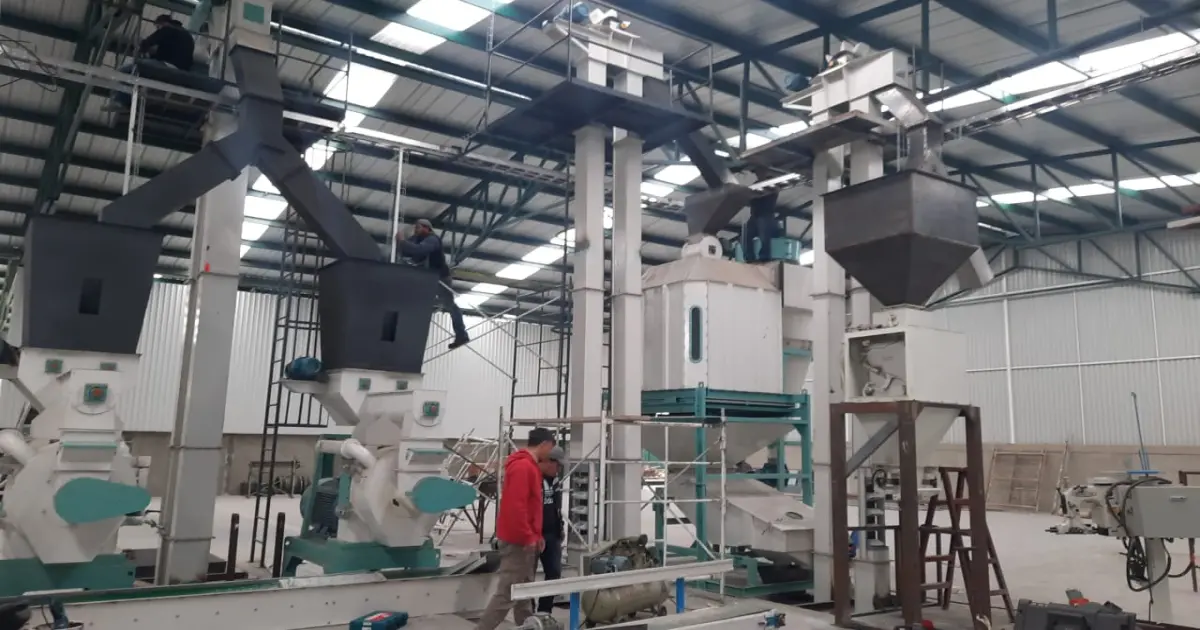
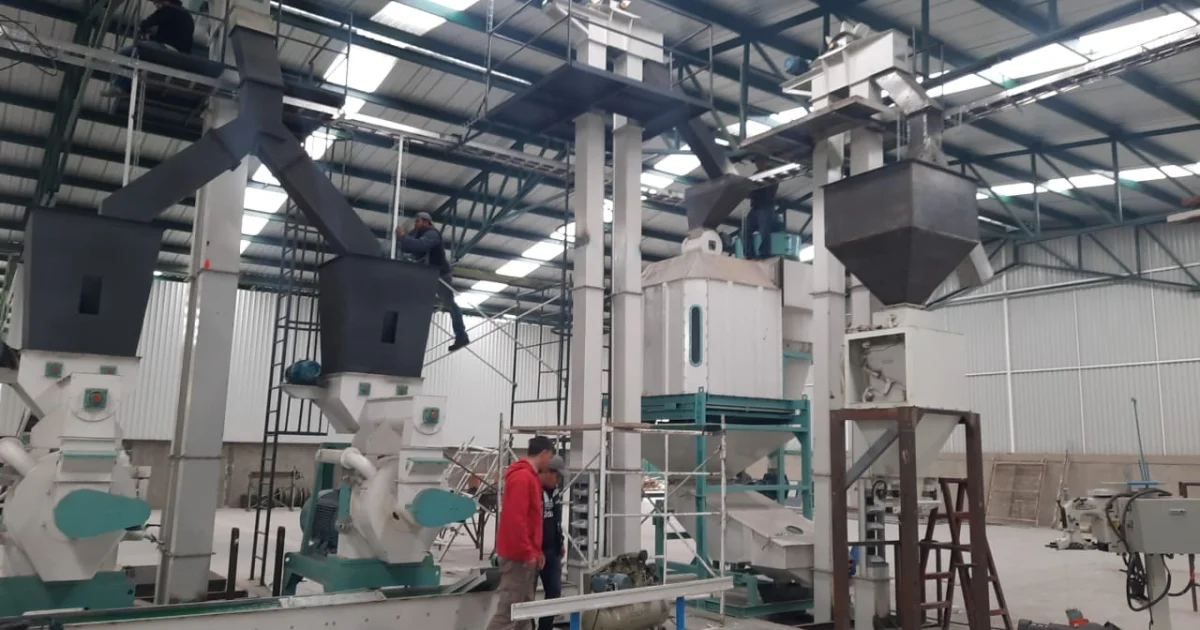
Industrial pellet mills for large-scale production use ring die technology:
- 1-2 t/h capacity: Single pellet mill with 250-400 kW motor
- 5-10 t/h capacity: Multiple pellet mills in parallel, each 400-800 kW
- Die specifications: 6 mm hole diameter is standard for heating pellets, 8 mm for industrial/power plant pellets
- Compression ratio: 1:4 to 1:6 for softwood, higher ratios needed for hardwood
6. Cooling
Counterflow coolers reduce pellet temperature from 80-90 degrees C to within 5 degrees of ambient. Proper cooling is essential for pellet durability and safe storage. Cooler capacity should match pellet mill output with a 10-15% safety margin.
7. Screening and Fines Recirculation
Vibrating screens remove fines (dust and broken pellets) which are recirculated to the pellet mill. A well-designed system maintains fines content below 1% in finished product (ENplus A1 requires below 1%).
8. Storage and Packaging
Options range from bulk storage silos (500-5,000 tons) for industrial customers to automated bagging lines for retail markets (15 kg bags). Bulk loading systems with dust suppression handle truck or rail car filling at 50-200 tons/hour.
Plant Layout Considerations
An efficient plant layout follows the material flow logic and considers:
- Linear flow: Raw material in one end, finished product out the other, minimizing material backtracking
- Elevation changes: Use gravity where possible to move material between stages, reducing conveyor requirements
- Fire separation: Dryer section, pellet storage, and raw material storage should be in separate fire zones
- Dust management: Centralized dust collection system connecting all transfer points and processing equipment
- Maintenance access: Allow crane access to major equipment and sufficient space for die and roller changes
Regulations and Certifications
- ENplus: The European Pellet Council's quality scheme is practically mandatory for European residential markets. Classes A1, A2, and B define quality parameters.
- PFI (Pellet Fuels Institute): North American equivalent certification for residential and commercial grades.
- ATEX compliance: European directive for equipment in explosive atmospheres - mandatory for all dust-handling zones in pellet plants.
- Environmental permits: Emissions limits for dryer exhaust (particulate matter, VOCs), noise ordinances, and water discharge permits.
- SBP (Sustainable Biomass Program): Required by many industrial power plant customers to verify sustainable sourcing.
Investment Overview
- 1 t/h plant: $500,000-1,200,000 total investment (equipment, installation, civil works)
- 3-5 t/h plant: $2,000,000-5,000,000 total investment
- 10 t/h plant: $6,000,000-15,000,000 total investment
Typical payback period ranges from 3 to 6 years depending on raw material costs, pellet selling price, and capacity utilization. With current market prices of $180-250 per ton for premium residential pellets and $120-160 for industrial pellets, margins are healthy for well-managed operations.
Conclusion
Installing a large-scale wood pellet plant is a significant investment that rewards thorough planning and quality equipment selection. The market fundamentals remain strong, driven by global energy transition policies and growing demand for carbon-neutral heating fuels. Meelko provides industrial pelletizing equipment and complete plant solutions for operations of all scales. Our engineering team can help you plan, design, and equip your pellet plant for long-term success. Contact us to start your project.