Short answer: the capacity of a pellet plant is chosen from the tons per year you will sell and the hours you will run. The same 3,000 tons a year calls for a 2 t/h plant on one shift and a 1 t/h plant on two. That decision changes the investment more than any other. Below, the calculation step by step and the plants from 300 kg/h to 10 t/h.
Step 1: real working hours
A pellet plant never runs every hour on the calendar. Start-ups, die changes, cleaning and maintenance take their share. As a reference for the calculation, with 85% effective time:
- One 8-hour shift, 22 days a month: about 1,800 hours a year.
- Two shifts: about 3,600 hours a year.
- Three shifts, 300 days a year, as many wood pellet plants run: about 6,100 hours a year.
Step 2: from tons per year to tons per hour
Divide annual output by effective hours. With a target of 3,000 tons a year:
- One shift: 3,000 / 1,800 = 1.7 t/h. That points to the 2,000 kg/h plant.
- Two shifts: 3,000 / 3,600 = 0.83 t/h. That points to the 1,000 kg/h plant.
- Three shifts: 3,000 / 6,100 = 0.5 t/h. The 800 kg/h plant is enough, with margin.
More shifts mean a smaller plant and a smaller investment, but they require more staff, night supervision and a raw material supply that never stops. For a newcomer, the usual approach is to size for two shifts and keep the third in reserve for growth.
Step 3: raw material defines the rest
A ton of pellets needs more than a ton of raw material, because water has to come out. Fresh sawdust can arrive with several times more water than the pellet mill accepts, and then the plant needs a dryer; alfalfa or feed, on the other hand, usually go in fairly dry. Before choosing the capacity, confirm there is enough raw material within a reasonable distance all year round: it is the factor that leaves the most plants idle. Sawdust pellet plant and flash dryer for biomass cover drying in detail.
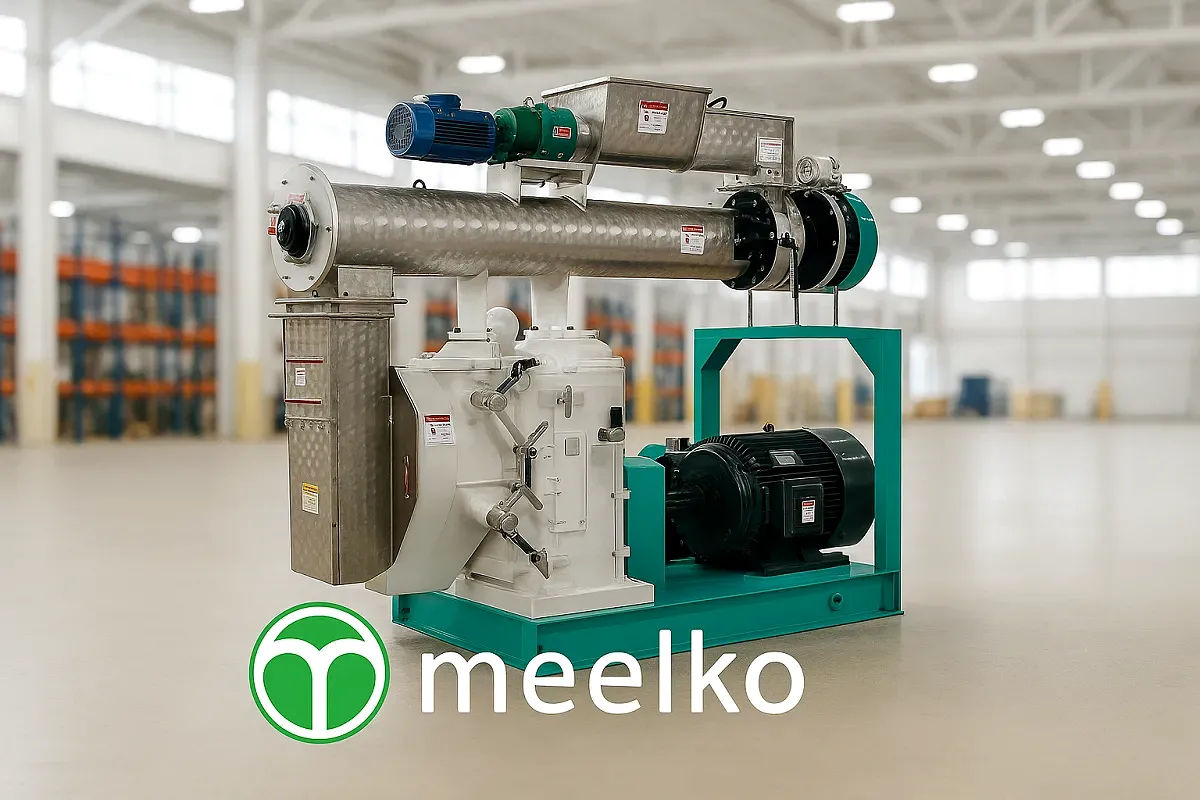
Meelko plants by capacity
All are complete lines, with grinding, mixing, pelletizing, cooling and screening; the final configuration depends on the material.
- 300 kg/h: mill, mixer, pellet mill, cooler and bagger. For feed, wood and biomass at small scale.
- 800 kg/h: modular line, with steam conditioning for feed.
- 1,000 kg/h: with the MKRD420C-W ring die pellet mill (90 kW).
- 1,500 kg/h: ring die line, expandable.
- 2,000 kg/h: twin line with two MKRD420C-W.
- 3,000 kg/h: with the MKRD508C-W ring die pellet mill (110 kW).
- 5,000 kg/h: twin line with two MKRD508C-W.
- 10,000 kg/h: large-scale automated plant.
Twin-line plants have an advantage that does not show on the spec sheet: if one pellet mill stops for maintenance, the other keeps producing. For a plant with delivery contracts, that is worth as much as capacity.
If the math gives less than 500 kg/h
Below about 500 kg/h sustained, a flat die pellet mill with its hammer mill is usually enough and much cheaper than a plant. Pellet mills from 120 to 400 mm lists the output of each size.
Three common mistakes
- Sizing on rated capacity without deducting hours. A 1 t/h plant does not produce 8 tons per shift.
- Not accounting for drying. With wet raw material, the dryer can be the largest and most energy-hungry machine in the line.
- Choosing with no room to grow. If the market responds, expanding a fixed plant costs more than choosing a modular or twin-line plant from the start.
Conclusion
A pellet plant's capacity comes from dividing the tons you will sell by the hours you will actually run, and from confirming the raw material is there. With that number, the plant model follows. Investment, consumption and profitability are covered in pellet plant costs and profitability, and installation in wood pellet plant installation. Meelko, an American brand of agro-industrial machinery, offers pellet plants from 300 kg/h to 10 t/h. Tell us how many tons a year you want to produce, from what raw material and how many shifts you plan to run, and we will propose the plant.