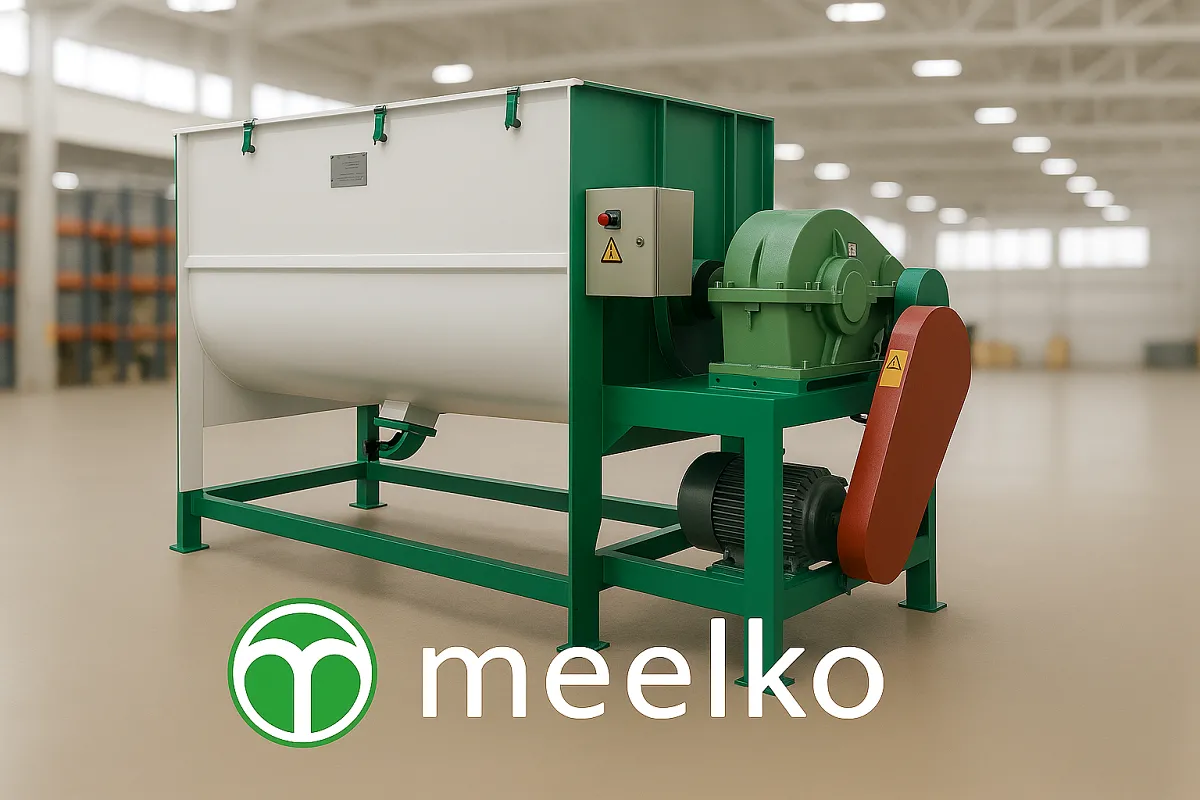
Short answer: you choose the mixer by the machine that comes after it. It has to deliver per hour at least what the pellet mill or extruder consumes. Meelko offers horizontal mixers of 150, 250 and 500 kg/h, from USD 3,686 to USD 10,387. Below are the models, the math and when a mixer larger than strictly needed makes sense.
Why good mixing matters
In a balanced feed, vitamins and minerals are a very small part of the formula. If they are not evenly spread, some animals get too much and others too little, even when the formula is right. The same happens in a fertilizer or in a flour with additives: an uneven mix shows up in the result and cannot be corrected later.
In a horizontal mixer, helical paddles move the material inside a closed chamber, which avoids dead zones and reduces dust. It works for balanced feed, flours, supplements and dry fertilizers.
The three models
- 150 kg/h: 2.2 kW, 1,930 × 600 × 1,100 mm, 184 kg. USD 3,686. For farms and small businesses.
- 250 kg/h: 4 kW, 2,350 × 706 × 1,240 mm, 344 kg. USD 5,757. For small feed factories.
- 500 kg/h: 7.5 kW, 3,000 × 900 × 2,110 mm, 1,300 kg. USD 10,387. For daily medium-scale production.
Compared by capacity, the price is similar across the three sizes: between USD 21 and USD 25 per kg/h. So is consumption: about 15 kWh per ton mixed. Unlike other machines, buying bigger does not bring the unit cost down much here: it is best to buy what the line needs.
The math: which one goes with each pellet mill
- MKFD120B (50 kg/h) or MKFD200C (150 kg/h): the 150 kg/h mixer. In the first case it is more than enough, but it is the smallest in the catalog and simply runs fewer hours.
- MKFD230C (120 to 200 kg/h): the 250 kg/h mixer, because the 150 would fall short when the pellet mill runs at the top of its range.
- 260 mm pellet mill (550 kg/h): the 500 kg/h mixer. It sits just under the maximum capacity; in practice, the line yields what the mixer delivers, about 500 kg/h.
- More than 500 kg/h: two mixers or a custom solution. Talk to us before buying.
A full example: to produce 20 tons per month with 22 days of 8 hours (176 hours), you need 114 kg/h. The 150 kg/h mixer covers that with margin and leaves room to grow to about 26 tons per month.
Before closing the numbers, confirm with us the batch time for your formula. That is what sets the real capacity per hour: a formula with many small ingredients needs more mixing time than a simple one.
What to look at besides capacity
- Space and height. The 500 kg/h mixer is over 2 meters tall. Plan how it is loaded: by hand, with a screw conveyor or with a bucket elevator. The options are in screw conveyor, bucket elevator or belt.
- Liquid ingredients. If the formula includes oil or molasses, let us know: it changes what the line has to do.
- The product. For human food or sensitive products, ask about the chamber material. It is not something to decide after buying.
- Cleaning between formulas. If you make feed for several species, allow time for cleaning: some additives must not carry over from one formula to another.
Where it fits in the line
The mixer goes after the hammer mill and before the pellet mill or extruder. If you are building the line from scratch, see setting up an animal feed line or, for poultry, which pellet mill for how many hens. For fertilizers, the fertilizer plant sizing tool works out the stages for your output.
Conclusion
A good mix does not show in the machine, it shows in the product. Choose the capacity from the next machine in the line and leave margin if you plan to grow. Meelko, an American brand of agro-industrial machinery, offers horizontal mixers from 150 to 500 kg/h. Tell us what you produce and how many kilos per hour you need, and we will tell you which one fits your line.