What a granulator does and why it defines the fertilizer business
Powdered fertilizer has three problems: it cakes with humidity, it segregates during transport and it is hard to dose in the field. Granulation solves all three. By turning powder into uniform granules of 2 to 5 mm, the product flows better, stores longer, can be applied with any spreader and sells at a higher price. That is why the granulator is the machine that defines the final quality and the margin of a fertilizer plant, whether it processes compost, treated manure or NPK blends.
At Meelko we work with two granulation technologies, each with its own logic, capacity range and ideal raw material: the pan granulator (also called disc granulator) and the roller press granulator (compaction granulator). This guide explains how each one works, which capacities they cover and which questions you need to answer before investing.
Pan granulator: agglomeration by rolling
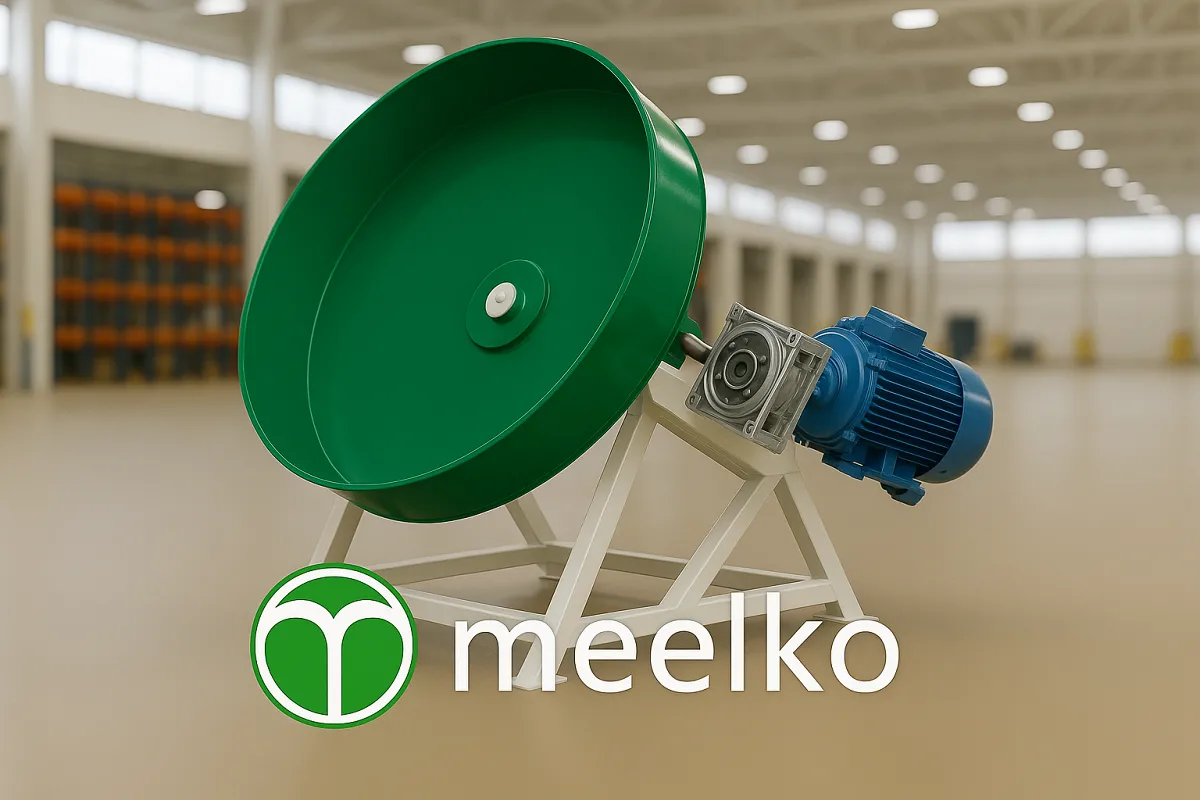
A pan granulator is a tilted disc, usually set between 45 and 55 degrees, rotating at an adjustable speed. Powder enters at the top while a set of nozzles sprays water or a binder solution. Particles get wet, collide and grow by rolling, forming balls that get bigger with every turn. When a granule reaches the target size, its own weight makes it overflow the lower rim of the pan, while smaller particles keep rolling until they grow. This natural classification is the great strength of the system: with the right tilt and speed, more than 90% of the output falls within the target size range.
Best suited materials
- Organic fertilizers: compost, poultry, cattle or swine manure, vermicompost, biogas digestate, peat.
- Organic-mineral blends: compost enriched with urea, phosphate or potassium.
- Fine mineral powders: agricultural lime, gypsum, dolomite, sulfur with a binder.
The process runs with a material moisture of 25% to 35%. This means the granule comes out wet and needs a drying stage, usually a rotary dryer, to reach the 10% to 12% final moisture that allows bagging without caking.
Capacities and power in the Meelko range
Meelko pan granulators cover everything from the small producer to the mid-size plant:
- MKGD-300: 300 kg/h with a 3 kW motor, the entry point for cooperatives and start-ups.
- MKGD-500 and MKGD-600/700: 500 to 700 kg/h with 5.5 and 7.5 kW, the best-selling range for compost plants.
- MKGD-1200 and MKGD-2000: 1,200 to 2,000 kg/h with 15 and 18.5 kW.
- MKGD-3000: 3 tons per hour with 22 kW, for continuous industrial production.
Power consumption is the pan's strongest argument: producing one ton of granules takes only 7 to 10 kWh in the granulator itself. The real cost of the process is in drying, not in granulation.
Roller press granulator: dry compaction
The roller press granulator works on a different principle. Two counter-rotating rollers compress the powder with very high forces, forming a dense sheet that is then broken and screened into irregular but very compact granules. No water is added: the process runs dry, with materials below 10% moisture. This eliminates the drying stage, reduces the plant footprint and prevents soluble nutrients from being lost with process water.
Best suited materials
- Mineral fertilizers: ammonium sulfate, potassium chloride, potassium sulfate, phosphates.
- NPK blends: custom formulations where every granule must contain the exact nutrient ratio, with no segregation.
- Heat-sensitive materials: compounds that do not tolerate high-temperature drying.
Capacities and power in the Meelko range
- MKGR-300 and MKGR-400: 300 to 400 kg/h with 5.5 and 7.5 kW.
- MKGR-500 to MKGR-800/900: 500 to 900 kg/h with 11 to 18.5 kW.
- MKGR-1200 and MKGR-2000: 1,200 to 2,000 kg/h with 22 and 30 kW.
- MKGR-3000: 3 tons per hour with 45 kW.
Compaction needs roughly twice the power of a pan for the same capacity, but that difference is more than offset by not having to dry the product. In a mineral plant, the total energy balance usually favors compaction.
Head to head: pan vs. press
- Raw material: pan for organics and wet powders; press for dry minerals and NPK.
- Working moisture: 25% to 35% for the pan; under 10% for the press.
- Drying afterwards: mandatory with the pan; unnecessary with the press.
- Granule shape: spherical and uniform from the pan; irregular and very dense from the press.
- Consumption per ton: lower in the pan, but the dryer has to be added.
- Initial investment: a pan granulator costs 25% to 35% less than a press of the same capacity. For the complete line the gap narrows, because the pan needs a dryer and a cooler.
- Granule hardness: compaction produces granules that resist transport and mechanical handling much better.
How to size the right capacity
The most common mistake is buying for peak demand. A well-sized granulator runs between 70% and 85% of its nominal capacity during the shift. To calculate, start from the tons per year you expect to sell, divide by the effective production days (in practice 220 to 250 days) and by the real operating hours per shift, which rarely exceed 7 effective hours in an 8-hour shift. A producer planning 1,500 tons a year needs about 850 kg/h: in practice a 1,000 to 1,200 kg/h model, not an 800 kg/h one.
Keep in mind the equipment around the granulator as well. A complete line includes a mill to homogenize the incoming powder, a mixer if you work with formulations, the granulator, a dryer and cooler in the case of the pan, a screening unit and the bagging machine. Meelko's fertilizer plants deliver this integration ready-made in 1 to 2, 3 to 5 and 5 to 10 tons per hour, in both disc and roller compaction versions.
Five questions before buying
- What moisture does my raw material have when it reaches the plant? This almost decides the technology by itself.
- Do I have enough three-phase power? A 1 t/h line with a dryer needs 45 to 65 kW installed.
- What granule size does my market ask for? Mechanized application demands 2 to 4 mm with a tight tolerance.
- Will I change formulations often? Compaction allows quick changes; the pan needs moisture and tilt to be readjusted.
- How much floor space do I have? A pan line with a rotary dryer takes 2 to 3 times the footprint of a compaction line.
Conclusion
There is no universal granulator: there is the right one for your raw material, your volume and your market. Organics and wet blends call for a pan; minerals and NPK formulations call for compaction. Meelko manufactures both technologies in capacities from 300 kg/h to 3 tons per hour, plus complete plants up to 10 tons per hour, shipped directly throughout the Americas. If you are evaluating a project, contact us: with the moisture of your material and your projected volume we can point you to the exact model and the line that goes with it.