Short answer: they are two machines for two stages. A chipper cuts branches and logs into chips; a hammer mill takes already reduced material (chips, stalks, straw, husks) and turns it into fine particles. If your material already arrives chopped, a hammer mill is enough, from USD 1,338. If it arrives as whole branches, you need both stages. Below is how to decide and which model to choose.
How they differ
- Chipper: works with knives. It takes whole branches or logs and delivers chips several centimeters long. It reduces volume, makes chips for boilers or prepares wood for the next stage.
- Hammer mill: works by impact. The hammers strike the material until it passes through the outlet screen. It delivers a powder or fine particle, which is what you need to pelletize, briquette or compost.
The most common mistake is buying one thinking it will do the other's job. A chipper does not give the fine size a pellet mill needs, and a hammer mill is not meant to receive thick branches or logs: it needs material that is already reduced and dry.
How to decide based on what you have
- Straw, stalks, leaves, dry grass, husks, bagasse: hammer mill.
- Chips and carpentry offcuts: hammer mill.
- Sawdust: often already the right size. Go straight to drying if needed and pelletizing.
- Pruned branches and whole trees: first a chipper, then drying and a hammer mill.
- Green or wet material: the mills are recommended for up to 30% moisture. Above that they yield less and it is best to dry first.
Meelko does not currently list a chipper in the online catalog. If your project starts from whole branches or logs, tell us about it before buying and we will look at what makes sense for that first stage.
The hammer mills
Electric
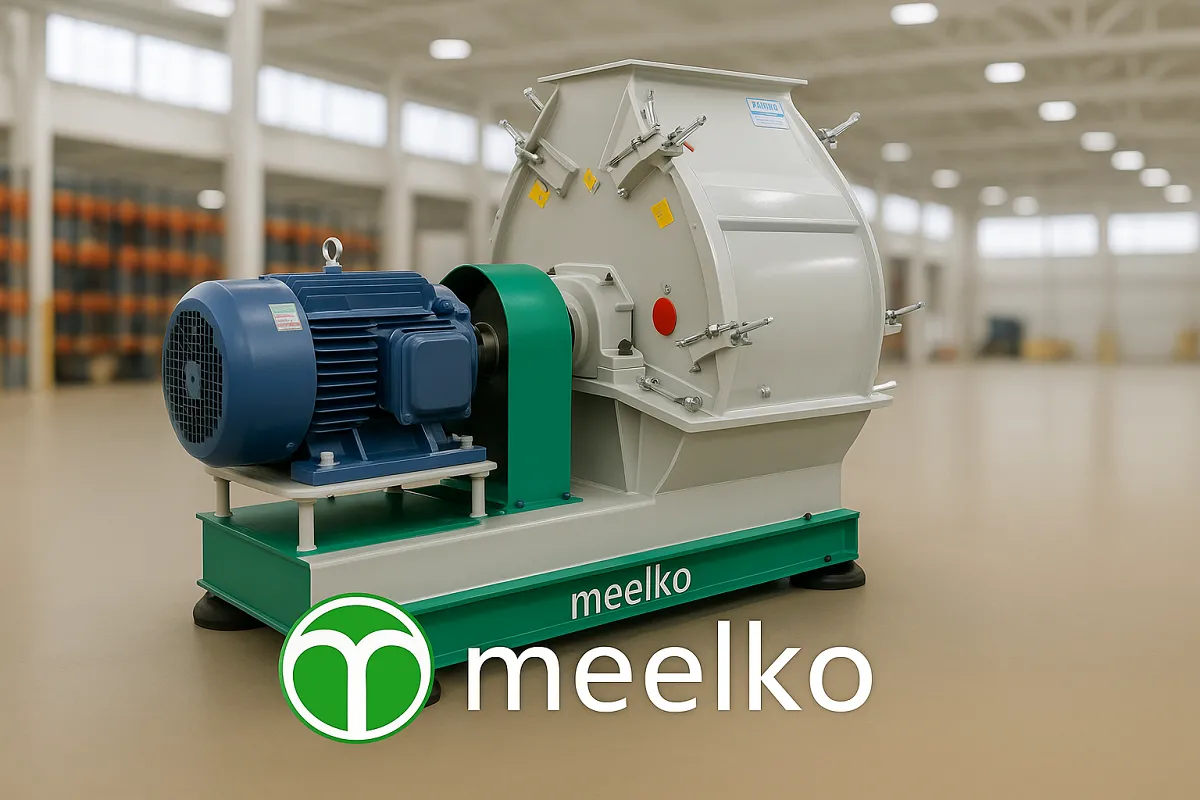
- MKH158B: 100 to 200 kg/h, 1.5 kW, single-phase. USD 1,338.
- MKH198B: 300 to 400 kg/h, 7.5 kW. USD 2,237.
- MKH500C: 900 to 1,500 kg/h, 22 kW. USD 5,538.
Diesel, if there is no grid power
The full comparison by energy type is in electric, gasoline or diesel hammer mill. Capacity changes with the material: hardwood yields less than straw.
The math: what size
The mill goes before the pellet mill or briquetter, so it must deliver at least what that machine consumes. Two examples:
- Workshop with 30 tons of wood offcuts per month, over 176 hours: 170 kg/h. The MKH198B covers it with margin.
- Pellet plant of 100 tons per month, over 176 hours: about 570 kg/h of product and a little more material. The MKH500C covers it and leaves margin in case the wood is hard.
Consumption is also a guide: the MKH198B uses about 21 kWh per ton at its average capacity, and the MKH500C about 18. At USD 0.12 per kWh, that is between USD 2 and USD 3 per ton.
What to do with ground biomass
- Pellets: for heating, boilers or animal feed. See wood pellets for stoves.
- Briquettes: for fuel. See charcoal briquettes.
- Compost and fertilizer: fine particles speed up the process. See granulated organic fertilizer.
Conclusion
Start by looking at how your material arrives: that tells you which machine you need. Meelko, an American brand of agro-industrial machinery, offers electric, gasoline and diesel hammer mills from 100 to 1,500 kg/h. Tell us what material you have, what size it arrives in and what you want to produce, and we will tell you which line makes sense.