Short answer: to turn poultry litter, manure or compost into granulated fertilizer, the central machine is a disc granulator, from USD 4,200 for 300 kg/h. But you have to compost, grind and mix first, and dry and screen afterwards. Below are the stages, the math for a 50,000-hen farm and when a complete plant makes sense.
Why granulate
Loose organic material is bulky, cakes, raises dust and is hard to spread in the field. Granulated, it can be bagged, shipped and applied with the same machine as a chemical fertilizer. It also changes the business: a residue you have to get off the farm becomes a branded product with a sale price.
The stages of the line
- Composting. Fresh material is stabilized before entering the line. It is the stage that takes the longest and most defines product quality.
- Grinding. Dry compost is reduced with a hammer mill so the granule comes out even.
- Mixing. A horizontal mixer adds additives or nutrients, if the formula calls for them.
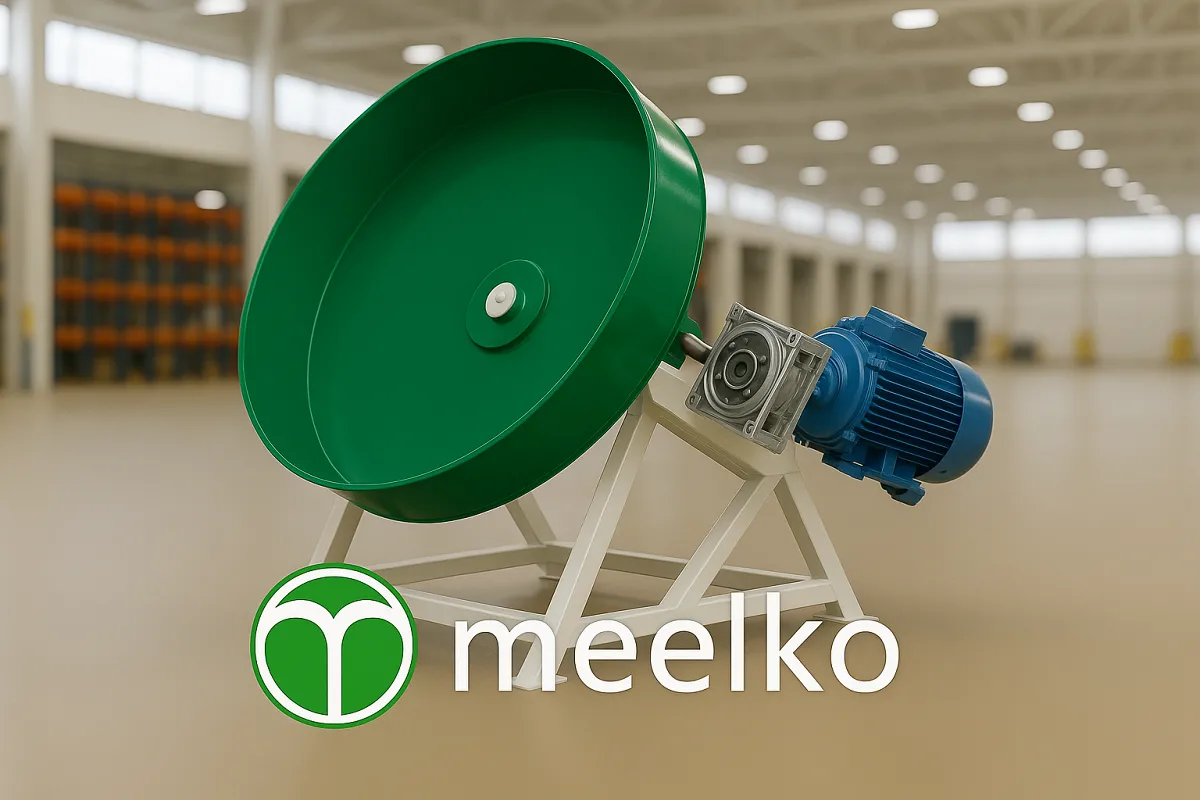
- Granulating. On an inclined disc, the damp powder rolls over itself and forms granules that grow until they leave over the edge.
- Drying and cooling. The granule comes out damp and has to be stabilized so it does not break or cake in the bag.
- Screening and bagging. Off-size material is separated and returned to the process; the rest is bagged.
The formula, moisture and binder depend on each material and are defined in the test with your raw material and during commissioning.
The math: a 50,000-hen farm
As a rough industry reference, each hen produces about 120 grams of fresh litter per day: 6 tons a day. Composting and drying reduce the weight a lot: assuming about half remains, that is about 3 tons of product a day.
In an 8-hour day, that is 375 kg/h. The MKGD-400 (400 kg/h, 4 kW, USD 5,100) is just enough, and the MKGD-500 (500 kg/h, 5.5 kW, USD 6,300) leaves margin. That is about 66 tons per month to sell, with 22 working days. To see if the numbers work at your prices, use the fertilizer plant profitability calculator.
The disc granulators
- MKGD-300: 300 kg/h, 3 kW. USD 4,200.
- MKGD-400: 400 kg/h, 4 kW. USD 5,100.
- MKGD-500: 500 kg/h, 5.5 kW. USD 6,300.
- MKGD-1200: 1,200 kg/h, 15 kW. USD 15,800.
- MKGD-2000: 2,000 kg/h, 18.5 kW. USD 22,500.
- MKGD-5000: 5,000 kg/h, 37 kW. USD 48,000.
To compare with pressure granulators, the article on fertilizer granulators explains the differences.
Single machine or complete plant
The granulator is one part of the investment. If you already have composting, a building and staff, you can build the line in stages. If you want to produce from 1 ton per hour with everything solved, the MKPF-P12 disc granulation plant (1 to 2 t/h, quoted on request) includes grinding, mixing, granulator, rotary dryer, cooler, screens, elevators and control panel. Reference prices for other plants are in how much a fertilizer plant costs, and the sizing tool works out the stages for your output.
Before buying
- Check the permits. In many countries, selling fertilizer requires registering the product and declaring its analysis. It is best to know before investing.
- Analyze the material. Sale value depends on nutrients and organic matter. A lab analysis tells you whether the product stands on its own or needs enriching.
- Find the market. Horticulture, fruit growing, nurseries and organic production usually pay better than broadacre crops. Selling bagged or in bulk changes the business.
Conclusion
The manure from a farm or feedlot can stop being a cost and become a product. Meelko, an American brand of agro-industrial machinery, offers disc granulators from 300 to 5,000 kg/h and complete plants. Tell us what material you have and how many tons a day you generate, and we will propose the line.