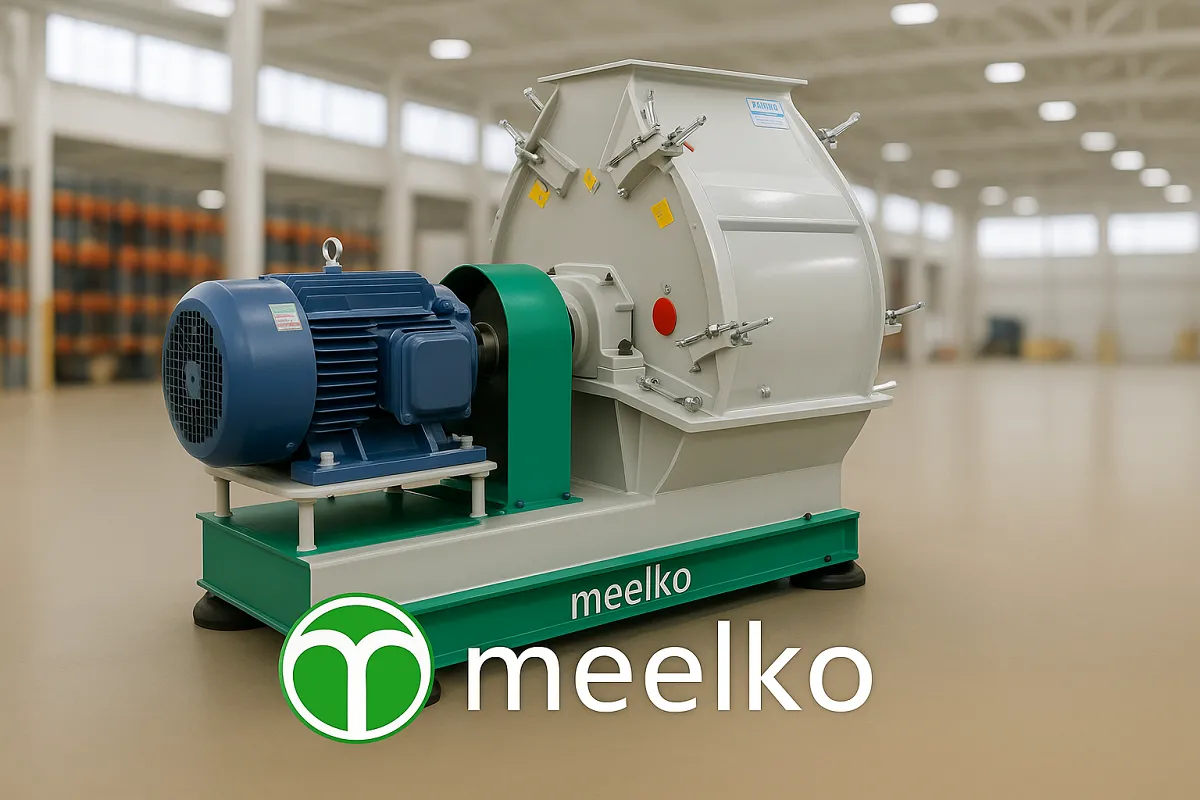
Short answer: without three-phase power, there are three ways to grind grain, forage or biomass with a hammer mill: a small single-phase electric unit (up to 200 kg/h), a gasoline unit (300 to 400 kg/h) or a diesel unit (up to 680 kg/h). With three-phase power, electric mills reach 1,500 kg/h and are the cheapest per kilo ground. Prices range from USD 1,338 to USD 12,668. Below, how to choose by power source and volume.
What a hammer mill is used for
Hammers spin at high speed, strike the material until it breaks and push it through a screen: the hole size sets the fineness. It works for almost anything dry: corn and other grains for feed, alfalfa and forage, crop residues, wood chips, sawdust and agricultural waste before pelletizing or briquetting, or for compost. It is not the mill for bread wheat flour: that needs a roller mill, as explained in hammer mill vs roller mill.
Three options by available power
Single-phase electric: the homestead or small farm
The MKH158B runs on 1.5 kW single-phase and grinds 100 to 200 kg/h. It costs USD 1,338 and weighs 80 kg. It is the option for grinding grain on a small farm, preparing poultry or pig feed, or feeding a 120 to 150 mm pellet mill.
Gasoline: off-grid, medium volume
They start anywhere and can be moved from one shed to another. The natural choice for farms with no grid power, work across different fields, or someone who grinds a few hours a week.
Diesel: off-grid, high volume
- MKH420A: up to 545 kg/h. USD 5,165.
- MKH420A-C: 22 HP diesel engine, up to 545 kg/h. USD 5,538.
- MKH500A: up to 680 kg/h. USD 11,284.
- MKH500A-C: up to 680 kg/h. USD 12,668.
Diesel handles long working days, and fuel is available in any rural town. It suits a grain store, a sawmill or a biomass plant far from the grid.
If you have three-phase power
With three-phase power, electric is almost always the best buy: it costs less, is quieter, needs no oil changes or refueling, and the energy cost per ton is usually the lowest.
- MKH198B: 7.5 kW, 300 to 400 kg/h. USD 2,237.
- MKH420B: 7.5 kW, up to 500 kg/h. USD 3,302.
- MKH420C-C: 11 kW, up to 700 kg/h, with fan and cyclone extraction. USD 5,006.
- MKH500C: 22 kW, 900 to 1,500 kg/h, with pneumatic cyclone extraction. USD 5,538.
Compared with its diesel counterpart, the electric unit of similar size costs much less: the MKH500C grinds more than the MKH500A at half the price.
How to choose: a simple calculation
Start from how many kilos you need to grind per day and how many hours you can spend on it. A dairy farm preparing 2 tons of ground corn per day in 4 hours needs 500 kg/h: with three-phase power, the MKH420B or, with margin, the MKH420C-C; without it, a diesel from the MKH420A series, rated up to 545 kg/h.
Two things change the result. First, the material: capacities on the product pages are indicative, and fibrous or moist biomass grinds slower than dry grain. Second, fineness: the smaller the screen, the fewer kilos per hour. If the mill feeds a pellet mill, it needs at least 30% more capacity so it does not hold it back.
Energy cost per ton
To compare with your prices: for electric, motor kW divided by tons per hour; the MKH500C, with 22 kW and 1.5 t/h, uses at most about 15 kWh per ton. For gasoline or diesel, engine liters per hour divided by tons per hour. With local kWh and fuel prices, the comparison is straightforward.
Common mistakes
- Choosing by maximum capacity. The "up to" figure is for dry material and an open screen: leave margin.
- Buying a fuel engine when you have three-phase power. It costs more to buy and to run.
- Forgetting the dust. Grinding produces fine dust: models with fan and cyclone run cleaner and are the better choice indoors.
If you will grind alfalfa for pellets, grinding for alfalfa pellets covers particle sizes.
Conclusion
A hammer mill is chosen by your power source and the kilos you will grind: single-phase for small jobs, gasoline or diesel for off-grid farms, three-phase electric for everything else. Meelko, an American brand of agro-industrial machinery, offers hammer mills from 100 to 1,500 kg/h in all three versions. Tell us what you will grind, how many kilos per day and what power you have, and we will point you to the model.