Short answer: bread-quality wheat flour is made with a roller mill that separates the bran, not a hammer mill. A small roller mill produces 80 to 600 kg/h and costs between USD 4,657 and USD 22,512 depending on capacity and level of automation. To choose one, start from the tons of flour you will sell, work out how much wheat has to be milled per hour, and pick the model with margin. Below: the types of mill, the calculation and the models.
Rollers or hammers: which mill makes wheat flour
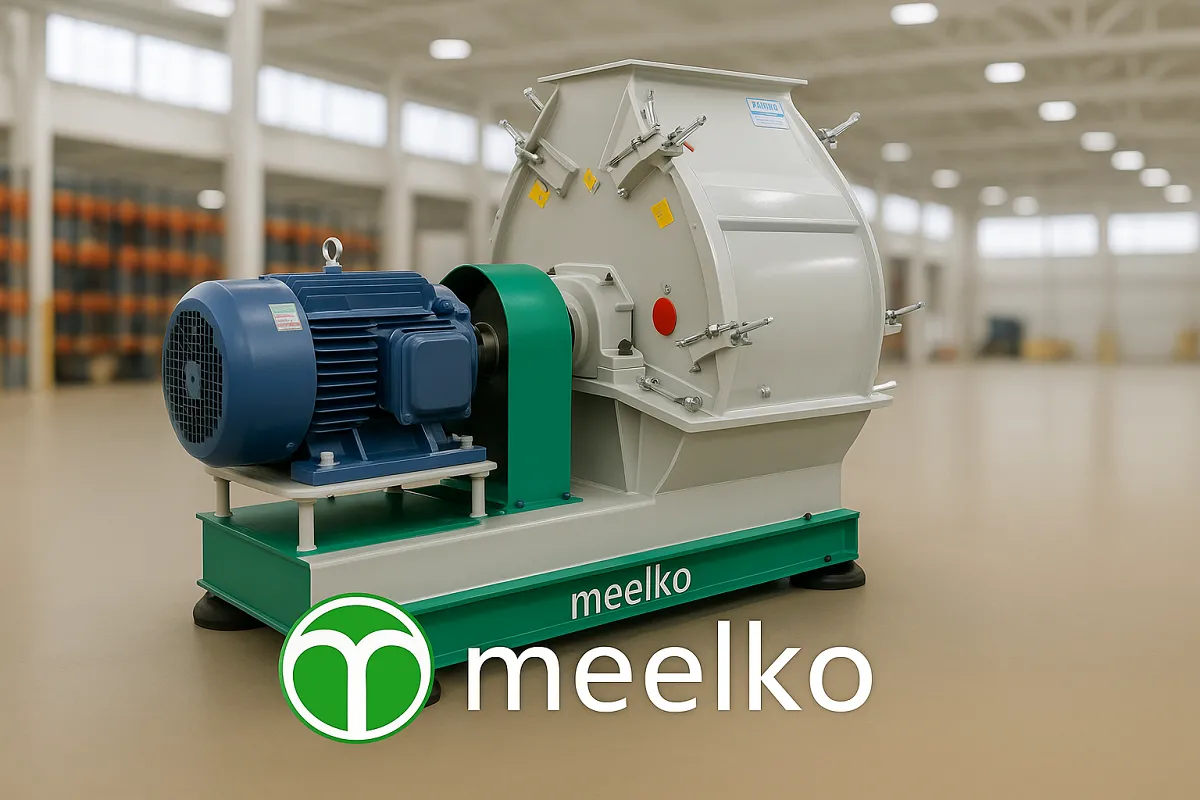
A hammer mill strikes the grain until it is pulverized: it works for animal feed, whole-grain flour and many dry products, but it mixes everything, bran included. A roller mill works differently: fluted rollers open and grind the grain progressively, an air and sieve separation system takes out the fine flour, sends coarse particles back for regrinding and delivers the bran through a separate outlet. The result is white flour for bread, and the bran becomes a second product sold as animal feed.
The full comparison of the two systems is in hammer mill vs roller mill.
The four types of small flour mill
1. Compact roller mills
A single machine, with the hopper on top and flour coming out ready to bag. The entry point for bakeries, small farms and start-ups.
- Up to 130 kg/h: 80 to 120 kg/h, 4 kW. USD 4,657.
- Up to 350 kg/h: 7.5 kW. USD 5,306.
- Up to 400 kg/h: 11 kW three-phase. USD 6,435.
- Up to 500 kg/h: 15 kW three-phase. USD 6,435.
- Up to 600 kg/h: 22 kW three-phase. USD 9,031.
2. MKFMA series
Roller mills from 280 to 500 mm, in standard (M), semi-automatic (AS) and higher-capacity (AD) versions. The semi-automatic version controls grain feeding and reduces operator intervention.
- MKFMA-28M: 100 to 150 kg/h, 5.5 kW. USD 5,322.
- MKFMA-50M: 200 to 250 kg/h, 11 kW. USD 8,742.
- MKFMA-28AS: 100 to 120 kg/h, semi-automatic. USD 7,832.
- MKFMA-40AS: 175 to 225 kg/h, semi-automatic. USD 10,904.
- MKFMA-40AD: 300 to 350 kg/h. USD 19,082.
- MKFMA-50AD: 400 to 500 kg/h, 27 kW in total. USD 22,512.
3. Complete kits
A mill with separation and flour discharge ready for bagging, as an assembled set. Some models are automatic with a double sifter and can be coupled in parallel to grow.
- 400 kg/h kit: semi-automatic, 9 kW. USD 6,854.
- 500 kg/h kit: automatic with double sifter, 17.2 kW. USD 12,136.
4. Stainless steel mills for human consumption
Food-grade stainless steel hammer mills with fan extraction and dust collection. They are not for bread wheat flour but for corn, cassava, plantain, coffee, spice and moringa flours and other dry products for human consumption.
- 100 to 200 kg/h: 11 kW. USD 21,381.
- 150 to 300 kg/h: 15 kW. USD 27,094.
The calculation: from tons of flour to the mill
From every 100 kg of wheat, a flour mill generally delivers 70 to 75 kg of white flour; the rest is bran and by-products. Take a business that wants to sell 30 tons of flour per month, working 22 days and 7 effective hours a day (154 hours):
- 30,000 kg of flour / 0.73 = about 41,000 kg of wheat per month.
- 41,000 kg / 154 hours = 266 kg of wheat per hour.
That volume calls for a 300 to 400 kg/h mill: the 400 kg/h compact mill on a tight budget, the 400 kg/h kit if you want flour ready to bag, or the MKFMA-40AD for long continuous runs. Capacities on the product pages are indicative and depend on the wheat and the fineness you want: size on the grain and leave margin.
Besides the flour, that mill leaves about 11 tons of bran per month. Sold to local dairy or pig farmers, it is income many people forget when doing the math.
What to plan for besides the mill
- Clean grain. Stones, soil and foreign seeds end up in the flour and wear the rollers. Wheat is cleaned and conditioned before milling; this is defined with the supplier at commissioning.
- Power. From 400 kg/h up, the mills are three-phase; the 130 kg/h mill runs on 4 kW.
- Floor space. Kits and semi-automatic mills take up considerably more room than compact ones: the 500 kg/h kit measures about 2 × 2.2 × 2.2 m, against 1.2 × 0.7 × 0.9 m for the 600 kg/h compact mill.
- Packaging and permits. Selling flour for human consumption requires an approved facility and labeling that complies with your country's rules.
Mistakes to avoid
- Buying a hammer mill to make bread flour. You will get whole-grain flour with bran, which does not work for traditional baking.
- Choosing the exact capacity. If the math gives 266 kg/h, a 250 kg/h mill means overtime every day.
- Not accounting for bran. It is a quarter to a third of what goes into the mill: you need somewhere to store it and someone to sell it to.
Conclusion
A small flour mill is one of the most direct ways to add value to wheat: flour for bakeries and households, and bran for animal feed. Meelko, an American brand of agro-industrial machinery, offers flour mills from 80 to 600 kg/h, from compact units for start-ups to automatic kits and stainless mills for other flours. For the bigger picture on grinding, see also the guide to industrial grinding mills. Tell us what grain you will mill, how many tons of flour per month you want to produce and what power you have available, and we will point you to the model.