Short answer: charcoal briquettes are made by grinding charcoal fines or dust, mixing them with a binder and pressing them in a roller press that shapes them into pillows, balls or cubes. A residue that used to be sold cheap or thrown away becomes an even fuel for grilling and industrial use. Meelko presses range from 1 to 30 tons per hour and cost USD 8,653 to USD 147,561. Below: the process, the business and how to choose the press.
Where the raw material comes from
Anyone who produces, stores or distributes charcoal generates fines: charcoal breaks in the kiln, during bagging, in transport and in the warehouse. That dust and those small pieces cannot be sold as bagged charcoal and usually end up given away or discarded. The press recovers 100% of it: all the fines can go back to market as briquettes.
The same presses also process mineral coal dust, coke, anthracite, mineral powders and, depending on the model, biomass residues such as coconut shell, sawdust or bagasse.
The process in five stages
- Grinding: pieces are ground so all the material has an even size. A hammer mill handles this stage.
- Mixing with binder: charcoal does not bind on its own; it needs a binder and a little moisture. The binder type and ratio are defined by the dust and the briquette's use. A horizontal mixer gives an even mix.
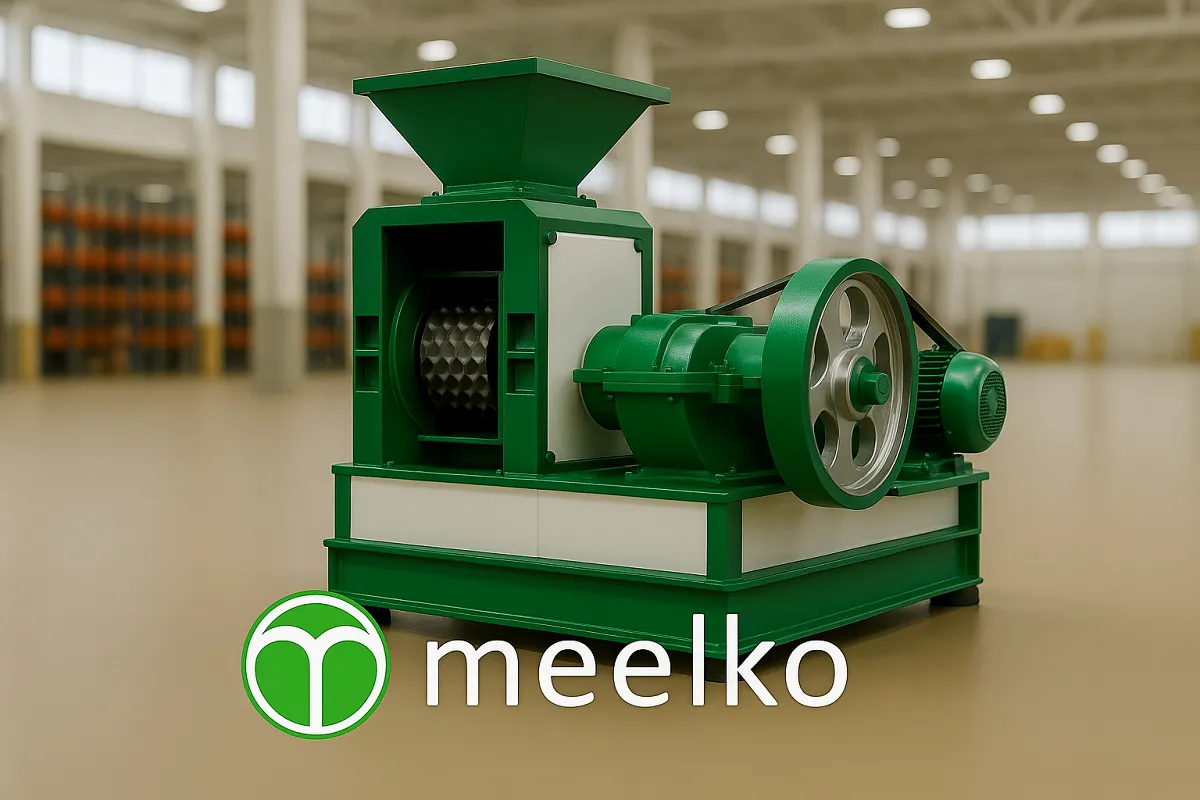
- Pressing: a conveyor carries the mix to the press, where two rollers with cavities compress and shape it. Some models have four rollers and press twice, giving denser, stronger briquettes.
- Drying: briquettes come out moist and must dry before bagging, in the open air or in a dryer.
- Bagging and sale.
The press is the heart of the line, but briquette quality depends as much on mixing and drying as on pressure.
Why briquettes sell well
- Even size: they light and burn uniformly, which lump charcoal does not offer.
- Longer burn: being dense, they last longer than the same weight of loose charcoal.
- Less dust and breakage: they reach the customer whole and bag cleanly.
- Two markets: home and restaurant grilling, and industrial fuel.
Models and reference prices
Meelko charcoal briquette presses, by capacity:
- MKBC02: 1 to 2 t/h, 5.5 kW. USD 8,653.
- MKBC04: 4 t/h, 15 kW. USD 14,054.
- MKBC06: 6 t/h, 18 kW. USD 19,671.
- MKBC08: 8 t/h, 22 kW. USD 28,859.
- MKBC10: 10 t/h, 30 kW. USD 44,009.
- MKBC15: 15 t/h, 45 kW. USD 54,316.
- MKBC20: 20 t/h, 75 kW. USD 122,964.
- MKBC30: 30 t/h, 90 kW. USD 147,561.
How to choose the press
Because charcoal presses have high hourly capacity, the bottleneck is almost never the press but how many fines are available and how much can be dried per day. A distributor collecting 100 tons of fines a month, working 22 days, processes about 4.5 tons a day: the MKBC02 does it in a few hours daily. The large presses make sense for industrial charcoal producers, mining or plants processing mineral coal and coke at scale.
Before choosing, add grinding, mixing, conveying and drying space: with the MKBC02, the rest of the line can cost as much as the press.
Mistakes to avoid
- Buying a large press without a secured raw material supply. An MKBC10 needs 10 tons of fines per hour to run at full capacity.
- Underestimating drying. A poorly dried briquette breaks in the bag and lights badly.
- Choosing the binder without testing. The wrong binder for the type of charcoal gives briquettes that crumble or smoke.
If your raw material is biomass rather than charcoal, benefits of biomass briquetting explains the differences.
Conclusion
Charcoal briquettes turn a low-value residue into a product with its own market, and the entry investment is moderate. Meelko, an American brand of agro-industrial machinery, offers briquette presses from 1 to 30 tons per hour, with mills and mixers to complete the line. Tell us what charcoal you have, how many tons a month and what briquette shape you want to sell, and we will point you to the model.