Short answer: a small oil plant is built around a screw press that splits the seed into two saleable products: crude oil and press cake (expeller) for animal feed. Presses range from 30 to 850 kg/h of seed and cost between USD 2,822 and USD 20,820. To choose one, start from how many tons of seed you will process per day. Below: how it works, the calculation with an example, and the models.
How an oil press works
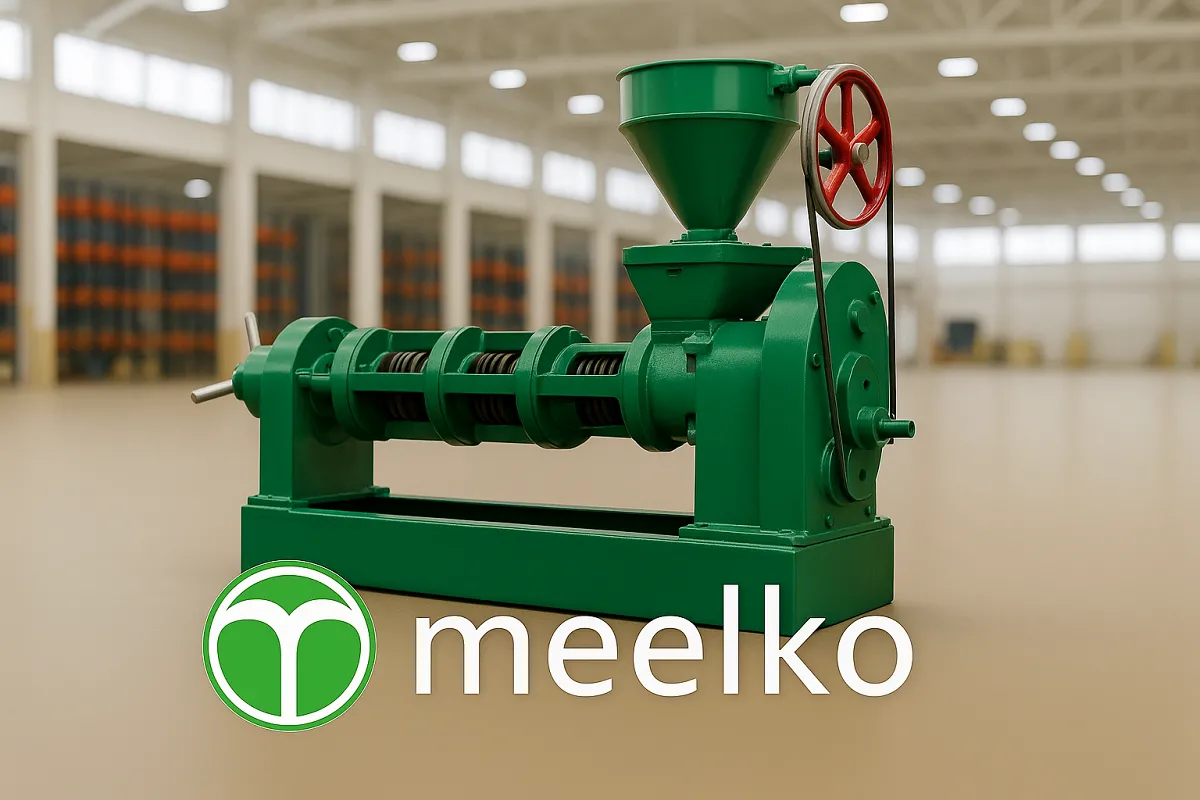
Seed enters through a hopper and a helical screw pushes it into an increasingly narrow cylindrical chamber. The pressure breaks the seed cells and the oil flows out through the slots in the chamber into a collector; the solid part moves to the end and comes out as cake. It is all mechanical, with no chemical solvents, so the oil can be sold as "pressed" and the cake keeps its value as feed.
Meelko presses process soybean, sunflower, peanut, rapeseed, cottonseed, sesame and flax, and the product pages for the medium and large models state extraction of more than 85% of the oil contained in the seed.
How much oil each seed contains
The business changes a lot with the seed, because each has a different oil content. As a general reference:
- Sunflower, rapeseed: around 40% to 45%. Lots of oil: oil is the main product.
- Peanut (shelled), sesame: 45% or more. Higher-priced oils, niche markets.
- Soybean: around 18% to 20%. Little oil, but a high-protein cake: with soybean, the core business is usually the expeller for dairy, feedlot, pig and poultry producers, and oil is the secondary income.
The calculation: a sunflower example
Take a cooperative that wants to process 2 tons of sunflower per day in one shift, with 7 effective hours:
- 2,000 kg / 7 hours = 286 kg/h of seed.
- With 42% oil seed and 85% extraction: 2,000 × 0.42 × 0.85 = about 700 kg of crude oil per day.
- The rest, about 1,300 kg, is cake for animal feed.
The 200 to 330 kg/h press covers that volume with no margin; the 350 to 500 kg/h press leaves room to grow or to work fewer hours. These are estimates: actual yield depends on the variety, moisture and cleanliness of the seed, and on how the press is set up at commissioning.
To see whether the business works, multiply those kilos by your local prices: crude oil in bulk or bottled, and cake per ton. Subtract seed, energy (the 200 to 330 kg/h press has 15 kW) and labor. In many regions, the cake pays for a good part of the seed.
Models and reference prices
Meelko oil presses, by seed throughput:
- 30 to 40 kg/h: 5.5 kW. USD 2,822. For trials, gourmet oils and family production.
- 80 to 125 kg/h: 5.5 kW. USD 5,221.
- 150 to 200 kg/h: 7.5 kW. USD 5,792.
- 200 to 330 kg/h: 15 kW. USD 8,965.
- 350 to 500 kg/h: 18.5 kW. USD 11,128.
- 550 to 700 kg/h: 22 kW. USD 14,633.
- 600 to 850 kg/h: 30 kW. USD 20,820.
For oil palm, which is processed differently, there is a 300 to 500 kg/h palm oil press (15 kW, USD 5,983) and a complete 8 t/day line (USD 62,315) including sterilization, threshing, digestion, pressing, clarification and oil drying.
What goes around the press
- Seed cleaning: stones, metal and soil damage the screw and dirty the oil. A screen or cleaner before the press is a must.
- Feeding: above 200 kg/h, loading by hand stops being practical. A screw conveyor carries seed from the hopper or silo.
- Oil filtering: oil leaves the press with fine particles. It has to be settled or filtered before bottling.
- Tanks and packaging: for the oil, and bags or a silo for the cake.
If you plan to feed the cake into a feed mill, setting up an animal feed production line covers the rest of the process.
Mistakes to avoid
- Counting only the oil. With soybean, cake is most of the income; with sunflower, it is more than half the kilos. Have a buyer for both products before buying the press.
- Choosing a press with no margin. Capacity changes with the seed: leave headroom over the calculated volume.
- Forgetting filtering and permits. To sell edible oil, the facility and product must be approved under your country's rules.
Conclusion
A small oil plant turns one seed into two products with their own markets, and the math starts from tons of seed per day. Meelko, an American brand of agro-industrial machinery, offers oil presses from 30 to 850 kg/h for soybean, sunflower, peanut, rapeseed and other oilseeds, and lines for oil palm. Tell us what seed you will process, how many tons per day and what you will do with the cake, and we will point you to the model.