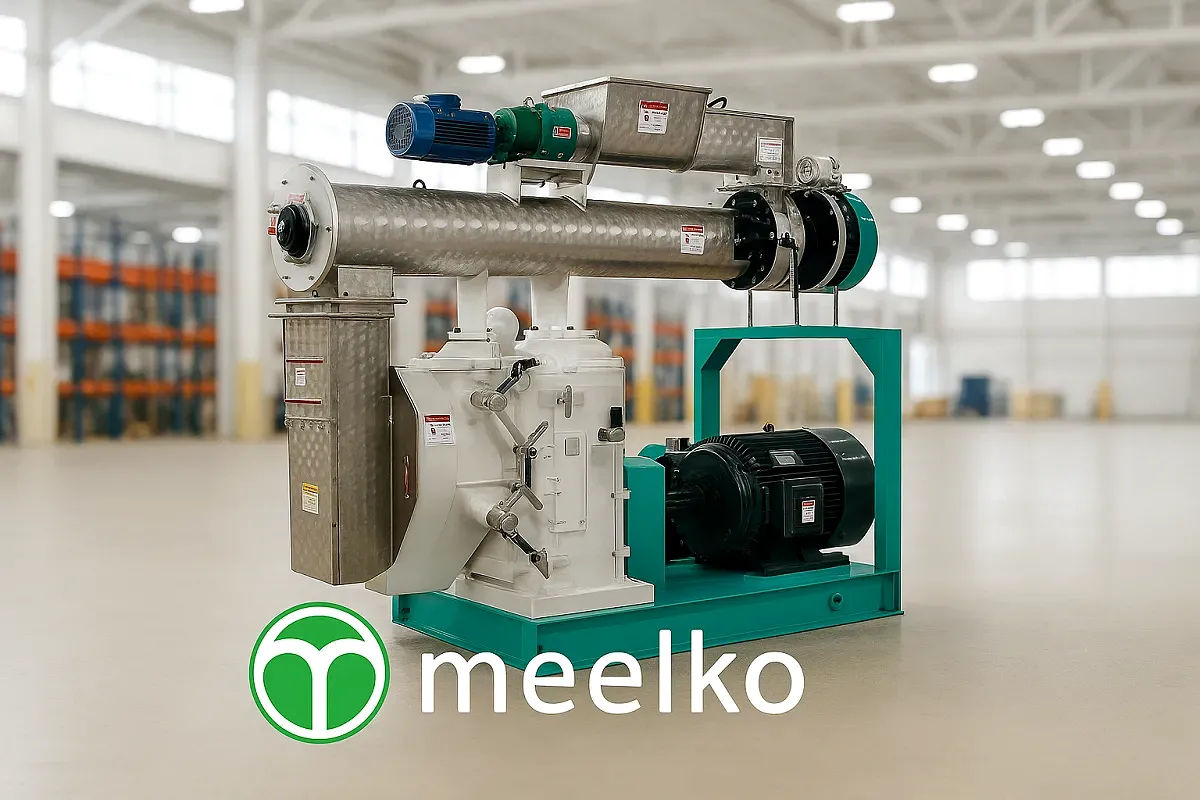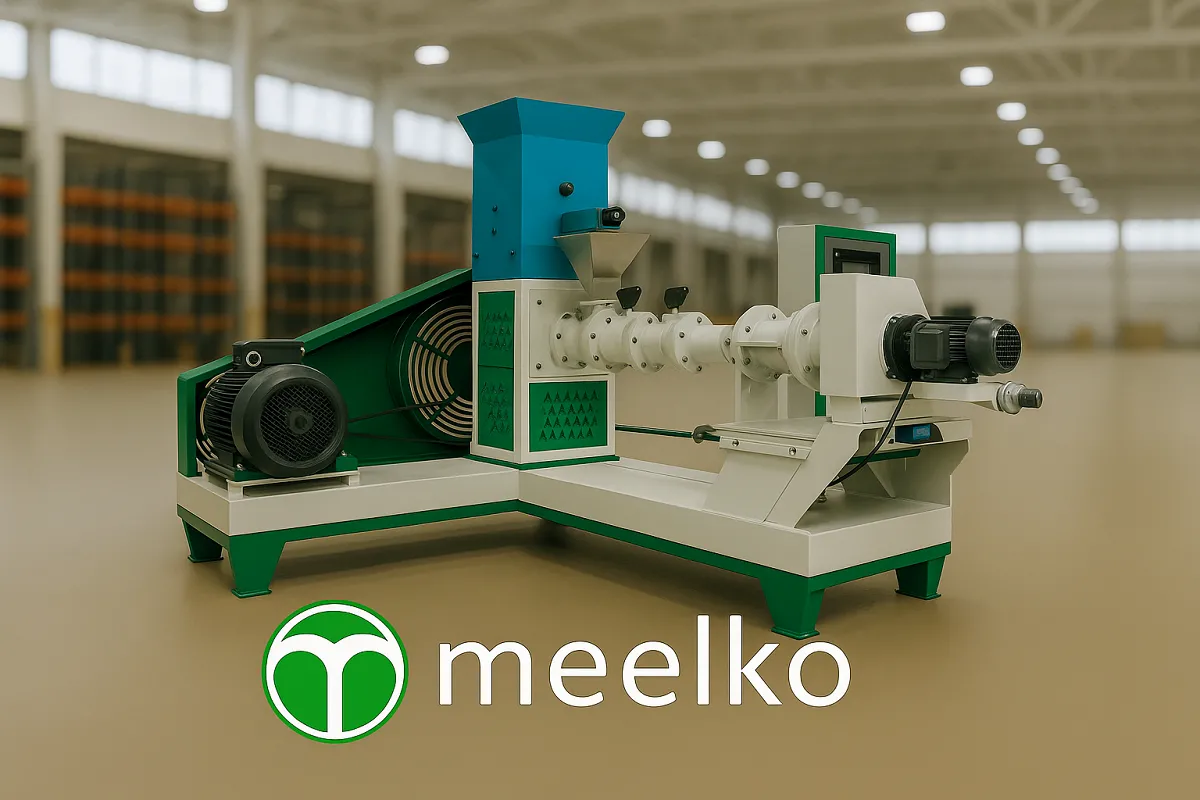
Short answer: floating fish feed is made with an extruder, not a pellet mill. You choose the capacity from the tons per month you plan to sell or feed on your own farm, and the machine ranges from about USD 7,000 for the 30 to 40 kg/h model to about USD 80,000 for the 3 to 4 tons per hour model. Below: why, how to work out the right model, and what has to go around the extruder.
Why fish feed is extruded
A pellet mill compresses meal through a die: the pellet comes out dense and sinks. That works for bottom feeders such as shrimp, but in tilapia, catfish or trout ponds a good part of that feed is lost before it is eaten.
An extruder works differently. It cooks the mix with pressure, temperature and moisture inside a barrel with a screw; the starch gelatinizes and, as it leaves the die, the pressure drop expands the kibble and traps air inside. That is why it floats. For the farmer this brings three concrete advantages:
- You see how much the fish eat: rations can be adjusted on the spot, and you stop throwing away feed that sinks uneaten.
- Better digestibility: cooked feed is used more efficiently than compressed meal.
- Water stability: extruded kibble stays firm longer and fouls the pond less.
An extruder can also produce slow-sinking or sinking feed by controlling expansion, so a single machine covers several species.
Who this business is for
Three kinds of buyers invest in a fish feed extruder:
- The fish farmer who makes their own feed. Feed is a farm's largest cost; producing it on site, with local corn, soybean or by-products, gives control over price and quality.
- The regional feed mill selling to fish farmers in its area, where floating feed is often expensive and shipped from far away.
- The pet food plant adding a fish feed line. Many people don't know this: the extruder is the same.
The same machine that makes dog and cat kibble
Meelko extruders for fish feed, dog food and cat food are the same equipment: what changes is the die, which sets the size and shape of the kibble, and the formula. A plant making dog food today can produce fish feed without buying another extruder, and one that starts with fish feed can diversify into pet food. For a new business that lowers the risk: the machine is not tied to a single market.
How to choose the capacity: a worked example
Extruder capacity is stated in kilograms per hour of extruded product, and two things must be deducted before comparing it with what you will sell:
- Drying: kibble leaves the extruder wet and loses around 15% of its weight before it is ready to bag.
- Real hours: start-ups, die changes and cleaning leave about 6.5 effective hours per 8-hour shift.
Take a plant that wants to sell 30 tons of feed per month working one shift, 22 days a month:
- 30,000 kg / 22 days = 1,364 kg of dry product per day.
- 1,364 kg / 6.5 hours = 210 kg/h of dry product.
- 210 / 0.85 = about 247 kg/h of extruded product.
The MKEW070B (220 to 280 kg/h, 18.5 kW) covers that volume with no margin. If the plan is to grow, the MKEW080B (320 to 400 kg/h, 22 kW) leaves room for 30% to 60% more without adding a second shift. Choosing a 150 kg/h machine because it is cheaper means running two shifts from the first month.
Models and reference prices
A selection of Meelko fish feed extruders, grouped by scale (the full list of 16 models is in the category). Prices are references for the extruder alone and are confirmed in the quote according to configuration and destination.
Start-up and pilot plant
First commercial plant
- MKED060C: 120 to 150 kg/h, 15 kW. USD 8,297.
- MKEW060B: 160 to 180 kg/h, 15 kW. USD 10,490.
- MKED070B: 180 to 200 kg/h, 18.5 kW. USD 11,148.
- MKEW070B: 220 to 280 kg/h, 18.5 kW. USD 18,957.
Regional feed mill
- MKED090B: 300 to 350 kg/h, 37 kW. USD 28,646.
- MKEW080B: 320 to 400 kg/h, 22 kW. USD 23,217.
- MKEW090B: 500 to 580 kg/h, 37 kW. USD 32,069.
- MKEW120B: 700 to 800 kg/h, 55 kW. USD 38,609.
Large scale
- MKEW135B: 1,000 to 1,150 kg/h, 75 kW. USD 46,671.
- MKEW160B: 1,700 to 2,000 kg/h, 90 kW. USD 72,517.
- MKEW200B: 3,000 to 4,000 kg/h, 132 kW. USD 80,235.
All of them have interchangeable dies, so the same machine makes kibble in different sizes for each growth stage, from fingerlings to grow-out.
What has to go around the extruder
The extruder is the heart of the line, but the result depends on what goes in and what happens afterwards:
- Grinding: fish feed needs a finer meal than dog food, because the kibble is smaller. A hammer mill such as the MKH198B (300 to 400 kg/h, 7.5 kW) supports an extruder of up to 250 kg/h; for larger plants, the MKH500C reaches 900 to 1,500 kg/h with 22 kW.
- Mixing: the formula combines grains, protein meals, oils and premixes in small doses, and it has to come out even. Meelko horizontal mixers range from 150 kg/h with 2.2 kW to 500 kg/h with 7.5 kW.
- Drying and cooling: the most underestimated stage. If the kibble does not reach an even moisture level, it molds in the bag.
- Oil coating (optional) and bagging.
As a power reference, a line with the MKEW070B, the MKH198B mill and the 250 kg/h mixer already adds up to 30 kW before the dryer: a three-phase supply is required.
Three mistakes to avoid
- Buying the smallest extruder on price and finding out it cannot keep up with the volume you can sell.
- Sizing only the extruder and not the grinding or drying, which end up being the bottleneck.
- Not defining the formula and locally available raw materials first: the type of kibble and the line configuration depend on them.
If your project also includes pet food, how to size a pet food production line explains the full line stage by stage, and setting up a complete animal feed production line gives the overall picture of a feed plant.
Conclusion
A fish feed plant starts with a simple calculation: the tons you will sell, the hours you will work and the real extruder capacity that produces them. Meelko, an American brand of agro-industrial machinery, offers fish feed extruders from 30 kg/h to 4 tons per hour, the same line that produces dog and cat food, along with mills and mixers to complete the plant. Tell us the species, the tons per month and the raw materials you have at hand, and we will propose the model and the line.